
Essay #4: How Chronic Disease Develops Over Time
The Inward Drift of Chronic Disease
One of the most puzzling features of chronic illness is how often it seems to arrive out of nowhere.
A person feels mostly fine for years, perhaps a little tired, a little stressed, a little achy. Then, suddenly, there is a diagnosis: autoimmune disease, diabetes, cardiovascular disease, depression, neurodegeneration. The question that inevitably follows is simple and unsettling:
How did this happen?
Modern medicine often answers with genetics, aging, bad luck, or lifestyle in the abstract. For many people, those explanations don’t quite fit. Nothing about the transition felt sudden from the inside.
To understand why, we need to look more closely at how the body actually works under stress, and why chronic disease so often represents the end point of a long, adaptive process rather than a sudden failure.
The pieces below highlight earlier discussions on symptoms. Click through to explore each topic in more detail.


How the Body Actually Works Under Stress
We are often taught to think of the body as a collection of parts: heart, gut, brain, immune system, each with its own job. When something goes wrong, we look for the broken part and try to fix it.

In reality, the body behaves far more like a living network. It is constantly adjusting, redistributing resources, and compensating for change.
The body has remarkable balancing and counterbalancing mechanisms that allow it to survive stress, scarcity, injury, and disruption, sometimes for years at a time.
Energy is finite. Repair capacity is finite. Attention is finite.
When one system is under strain, others adjust to compensate.
This is the essence of systems biology, even if we never use the term.
The body does not ask, “How do I feel?”
It asks, “How do I adapt in order to survive?”
When stress is brief, these balancing mechanisms are efficient and reversible. When stress is chronic, metabolic, inflammatory, emotional, environmental, and gastrointestinal the body must make tradeoffs.
Something always pays the price.
Survival Before Comfort, But Never Without Intelligence
This leads to an important truth:
The human body is extraordinarily adaptive. Its primary goal is not comfort or even longevity, it is survival.
In the short term, this is a strength. The body can push through illness, injury, emotional strain, sleep deprivation, and nutritional shortfalls. It keeps vital systems online by reallocating energy and attention.
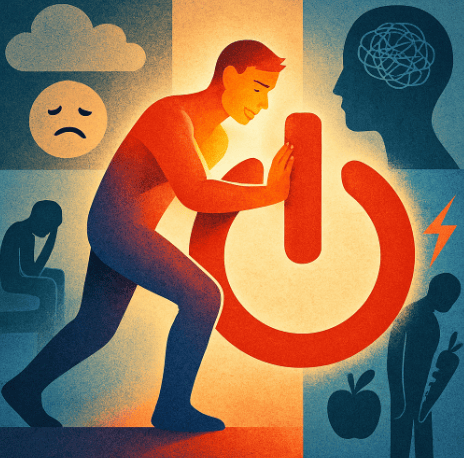
But this adaptation is not blind or random. It is intelligent.
And crucially, it never disappears.
Even in advanced illness, the body retains an inherent drive toward balance and repair. What changes over time is not the presence of resilience, but the conditions required for it to express itself.
“I Got Migraine”: Why Disease Feels Sudden
This is why people so often describe illness with phrases like:
- “I got migraine.”
- “I got irritable bowel.”
- “I got an autoimmune disease.”
The language makes sense. Diagnosis feels like a moment, an appointment, a test result, a name. It can feel as though the disease arrived unexpectedly, as if it attacked from the outside.

But biology doesn’t work in moments.
It works in processes.
Diagnosis is rarely the beginning of the disease. It is usually the moment when a long period of underlying dysfunction finally crosses a line that medicine knows how to name.
What feels sudden is often the recognition of a process that has been unfolding quietly for years.
This distinction matters. When disease is framed as something that “happened” to us, it appears random and disconnected. When it is understood as something that emerged over time, it becomes intelligible, and potentially reversible.
From Loud Signals to Quiet Imbalance
Early imbalance tends to announce itself clearly:
- Pain
- Inflammation
- Digestive upset
- Anxiety
- Sleep disruption
- Episodic fatigue
These symptoms are uncomfortable, but they are also informative. They are the body’s first attempts to signal that its balancing capacity is being exceeded and that change is required.
When these signals are repeatedly suppressed, without addressing the conditions that created them, the body often shifts strategy. Instead of expressing distress at the surface, it absorbs the burden internally.
This is the beginning of the inward drift of chronic disease.
How Imbalance Moves Inward Over Time
Seen through a systems lens, chronic illness often follows a recognizable pattern:
- Peripheral and Functional
Symptoms are localized and intermittent:
- Muscle pain
- Headaches
- Skin conditions
- Bloating or reflux
- Stress-related sleep disruption
At this stage, the body’s balancing and counterbalancing mechanisms are strained but flexible. Recovery can often occur with relatively modest changes.
- Systemic and Regulatory
Imbalance becomes more diffuse:
- Hormonal disruption
- Chronic low-grade inflammation
- Immune dysregulation
- Nervous system hyperarousal
- Metabolic inflexibility
Symptoms are less dramatic but more persistent. Resilience is reduced, not lost.
- Structural and Diagnosable
Eventually, adaptive strain becomes visible as disease:
- Autoimmune conditions
- Type 2 diabetes
- Cardiovascular disease
- Neurodegenerative processes
- Chronic mood disorders
At this stage, restoration often requires more time, more support, and more comprehensive change, but the capacity for repair is not absent.
Where the Medical System Struggles to See This
Here, an important contrast becomes clear.
The medical system was built to identify and treat discrete problems:
- An infection
- A tumor
- A blocked artery
- A failing organ
In these contexts, isolating a part and intervening decisively works extraordinarily well.
But chronic disease does not arise from a single broken part. It emerges from long term strain across multiple interacting systems, metabolic, immune, neurological, hormonal, adapting together over time.
A medical system structured to look for:
- One cause
- One diagnosis
- One target
- One treatment
The struggle to recognize problems that exist in the relationships between systems rather than in any single component.

This is not a failure of doctors.
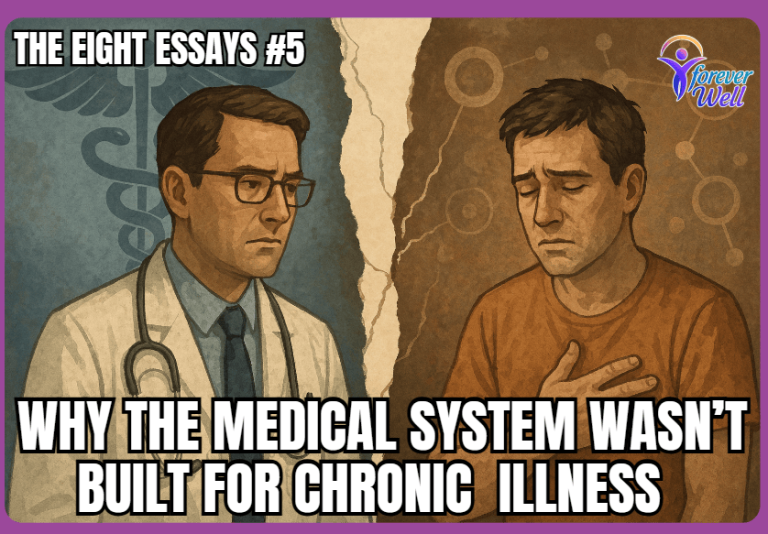
It is a mismatch between how the body behaves and how the medical system has been trained to think.
Suppression, Timing, and the Persistence of Resilience
Symptom suppression does not create chronic disease. But when suppression replaces restoration, it can accelerate inward adaptation.
Each time a symptom is silenced without changing the conditions that produced it:
- The original stressor may persist
- The body compensates elsewhere
- Tradeoffs grow more complex
Over time, the body learns to function under constraint. That adaptation keeps people going, but it also narrows the margin for error.
Still, adaptation is not damage.
And constraint is not destiny.
Resilience never leaves. Given the right environment, reduced load, restored resources, coherent support, the body’s balancing and counterbalancing mechanisms remain available at every stage of life.
A Different Way to Understand Chronic Illness
Seen through a systems biology lens, chronic disease is not a collection of unrelated diagnoses. It is the long-term expression of unresolved adaptation.
This perspective explains why:
- People feel unwell long before diagnosis
- Symptoms migrate over time
- Multiple conditions often cluster together
- Lifelong management becomes normalized

It also reframes symptoms, not as enemies to be silenced, but as early invitations to change the conditions in which the body is operating.
Looking Ahead
In the next essay, we’ll turn our attention directly to the medical system itself, how training, diagnostics, and incentives evolved in ways that unintentionally favor late-stage intervention over early, systems-level restoration.
For now, this insight is enough:
Chronic disease rarely arrives unannounced.
And resilience, given the right environment, is never truly gone.
The task before us is not to overpower the body, but to create the conditions in which its natural intelligence can once again express itself.