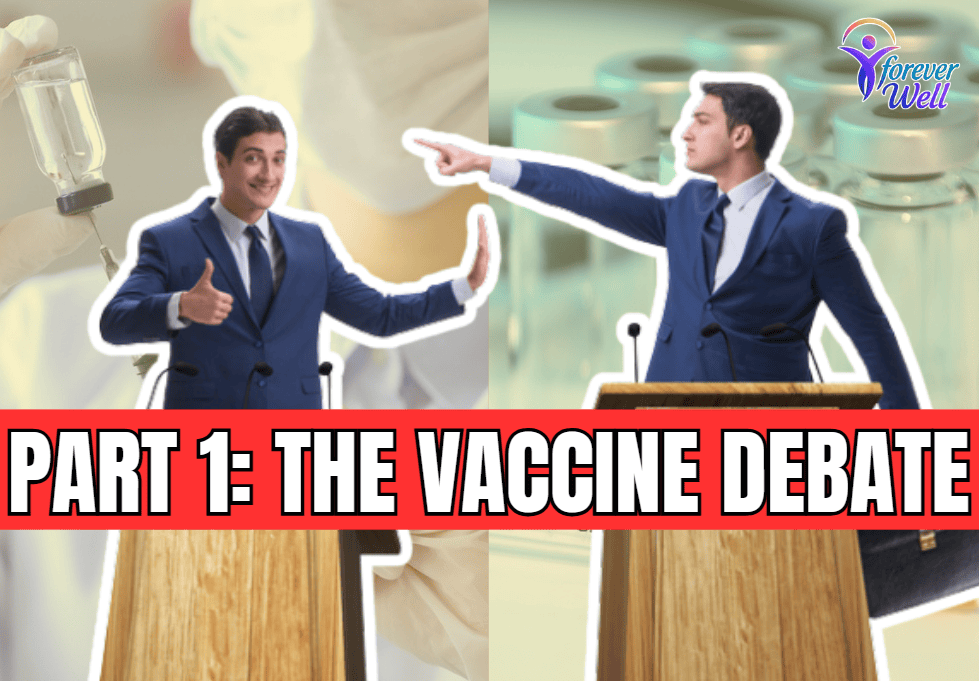
The Vaccine Debate: Finding Honest Answers and Better Questions Part 1
The public conversation about vaccines has rarely been calm. But with Robert F. Kennedy Jr. now leading the Department of Health and Human Services, the vaccine debate has become uniquely combustible.
For some, RFK’s appointment represents long-overdue accountability, a challenge to pharmaceutical power, regulatory complacency, and unanswered safety questions.
For others, it feels dangerous—an invitation to misinformation, erosion of public trust, and the revival of debates they believe were settled long ago.
If you are firmly in either camp, this series is written for you.
And if your instinct is to stop reading because the very mention of RFK triggers agreement or alarm, that reaction is precisely why this series matters.
This Is Not About RFK
Let’s be clear at the outset.
These essays are not an endorsement of RFK, nor are they an attack on him. They do not argue that vaccines are broadly unsafe, nor do they claim that public health officials act in bad faith. They are not an attempt to relitigate old culture-war talking points.

Instead, this series asks a different, and more important, set of questions:
- How is vaccine safety actually established?
- What kinds of harm can our current systems detect, and what kinds do they miss?
- How do incentives, liability structures, and institutional alignment shape what gets studied?
- What happens to biologically vulnerable subgroups in systems built around population averages?
- And what would a safety framework look like if it were designed around biology rather than messaging?
Those questions remain relevant regardless of who occupies the Secretary’s office.
Why This Moment Matters
RFK’s appointment has not created new questions about vaccine safety. It has exposed how unresolved those questions already were.
The intensity of the reaction, on both sides, reveals something important: our confidence in vaccine safety has been carrying more political and emotional weight than scientific transparency.
That is not a criticism of vaccines.
It is a critique of how certainty has been communicated in the presence of real biological complexity.
When public health debates become so polarized that asking basic methodological questions is interpreted as loyalty or heresy, everyone loses—especially children.
For Readers Who Support RFK
If you believe RFK is right to challenge pharmaceutical influence and regulatory complacency, this series will give you something stronger than slogans: a disciplined framework.
It distinguishes:
- Evidence from inference
- Incentives from intent
- Structural failure from conspiracy
It will likely temper some claims you may be inclined to make, but it will also strengthen the credibility of concerns that deserve serious attention.
For Readers Who Oppose RFK
If you believe RFK is wrong, dangerously so, this series is not an attempt to persuade you otherwise.
Instead, it asks whether:
- Our current safety systems are as comprehensive as we assume
- Population-level reassurance is sufficient for complex developmental biology
- And whether dismissing all concern as “anti-vaccine” has prevented legitimate inquiry
You may finish this series still disagreeing with RFK.
But you may also come away with a clearer understanding of why trust has eroded, and why slogans have not repaired it.
What This Series Will, and Will Not, Do
This series will:
- Examine vaccine safety through the lens of systems biology and homeostasis
- Explore why long-term and subgroup-specific data are limited
- Analyze how incentives and institutional alignment shape inquiry
- Propose a constructive, biologically grounded alternative
It will not:
- Claim vaccines are the primary cause of chronic disease
- Argue that benefits of vaccination are illusory
- Ask you to choose a political side
Its goal is simpler, and harder:
To replace reflexive certainty with informed humility, and polarized debate with better questions.

Why Reading All Three Essays Matters
Each essay builds on the last:
- Essay #1 examines what we do not know about long-term vaccine safety
- Essay #2 asks why those gaps persist and who benefits from not knowing
- Essay #3 outlines what a biologically honest safety system could look like

Taken together, they make a single argument:
That vaccine safety deserves the same intellectual maturity we now apply in other areas of medicine.
A Final Invitation
Whether you see RFK as a truth-teller or a threat, the deeper issue is not him. It is whether our medical institutions are capable of:
- Studying complexity without fear
- Protecting vulnerable children without erasing them statistically
- And evolving beyond a one-size-fits-all paradigm in a biologically diverse world
This series is not a rejection of medicine.
It is an invitation to let medicine evolve, to mature beyond averages, toward humility, resilience, and genuine protection of public health.
If that goal matters to you, regardless of where you stand on RFK, then these essays are worth your time.
ESSAY #1
The Data We Never Collected
Why Confidence in Vaccine Safety Exceeds the Evidence
Modern medicine frequently reassures the public that vaccines are “safe and effective.” For most people, this phrase signals that rigorous science has settled the question, that risks are known, measured, and acceptably small.
But over time, I have come to realize that this confidence rests on a quieter assumption: that the data needed to evaluate long-term safety actually exist.
In many cases, they do not.
This essay is not an argument against vaccination. It is an examination of what we know, what we do not know, and why those gaps matter, particularly when medical interventions are administered universally to healthy children.
What Vaccine Safety Trials Are Designed to Show

Pre-licensure vaccine trials are primarily designed to detect:
- Acute adverse reactions
- Short-term tolerability
- Immunogenic response
These trials are necessarily limited in size and duration. In several long-standing vaccine package inserts, solicited adverse events are monitored for only a few days following administration. Longer follow-up may capture serious adverse events, but not subtle, delayed, or developmental effects.
This design is not deceptive. It is pragmatic. But it answers only a narrow question: Does this intervention cause obvious, short-term harm in most people?
It does not answer:
- Whether cumulative exposure affects immune regulation
- Whether timing matters during critical developmental windows
- Whether a subset of children responds differently
- Whether long-term homeostasis is altered
Those questions are deferred to post-marketing surveillance.
The Limits of Post-Marketing Surveillance
Post-approval vaccine safety relies heavily on passive reporting systems and retrospective observational studies. These systems can detect large, unmistakable signals. They are poorly suited to identifying:
- Delayed outcomes
- Functional decline without a clear diagnosis
- Neurodevelopmental divergence
- Effects limited to biologically vulnerable subgroups
Crucially, reporting is inconsistent, enforcement minimal, and long-term longitudinal tracking rare.
The result is a safety architecture optimized to detect catastrophes, but not complexity.
Absence of Evidence Is Not Evidence of Absence
When public health agencies state that “vaccines are safe,” what they usually mean is something narrower:
No strong population-level safety signal has been detected.
That may be true. But it is not the same as demonstrating comprehensive long-term safety, particularly for complex, regulatory systems like immunity and neurodevelopment.
This distinction matters because childhood health has deteriorated across multiple domains over the same decades that vaccine schedules expanded. Allergies, asthma, autoimmune disease, obesity, and neurodevelopmental disorders have all risen markedly.
Correlation does not equal causation.
But correlation demands inquiry.
This raises the first question in this series:
If we lack long-term, stratified safety data, how confident should we be, and why were those data never collected?
That question leads directly to the second essay.