
Essay #2: Why Symptoms Don’t Show Up on Tests and You Still Don’t Feel Well
One of the most common, and most quietly discouraging, experiences in modern healthcare sounds like this:
“I don’t feel well. My energy is low. I’m not sleeping through the night. I feel anxious or foggy. Something is off.”

The doctor listens, orders tests, and reassures the patient that this is the right next step. Blood is drawn. Numbers are analyzed. A follow-up visit is scheduled.
Then comes the verdict:
“Your labs look normal.”
And yet, the patient still doesn’t feel well.
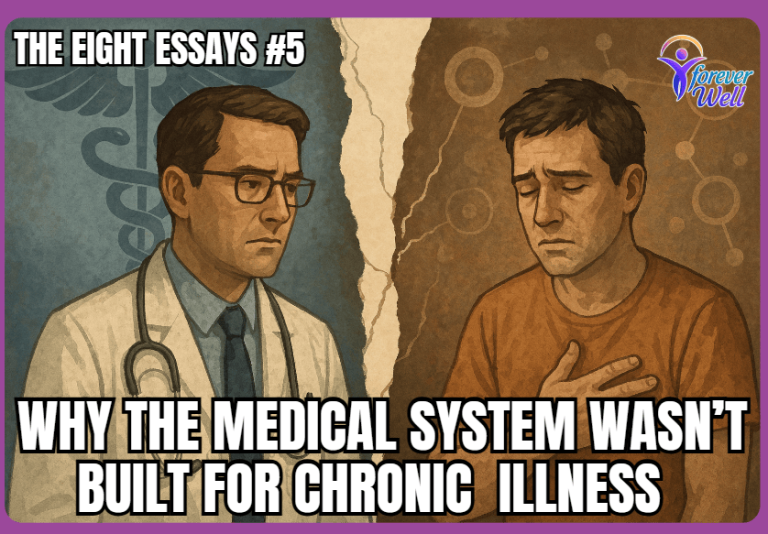
This moment, so familiar to millions of people, is where trust often begins to erode. Not because the doctor is uncaring, and not because the patient is imagining symptoms, but because two very different definitions of “health” are quietly colliding.

The Most Common Complaints Are the Hardest to Measure
Fatigue. Poor sleep. Anxiety. Brain fog. Low resilience. A sense that one’s body is no longer working the way it used to.

These are among the most frequent reasons people seek medical care, yet they are also among the least satisfying for physicians to evaluate.
Why?
Because these complaints are functional and experiential, while most diagnostic tests are structural and biochemical. The tools and the symptoms are often speaking different languages.
Modern diagnostics are excellent at answering questions such as:
- Is there organ failure?
- Is there advanced disease?
- Has a clear risk threshold been crossed?
- Is immediate intervention required?
They are far less effective at answering:
- Is this person producing energy efficiently?
- Is their nervous system chronically overactivated?
- Is their stress load exceeding their adaptive capacity?
- Is their biology quietly drifting toward dysfunction?
The patient is asking the second set of questions.
The tests are designed to answer the first.
What “Normal” Actually Means
When patients hear “normal,” they understandably assume it means “healthy.”
In reality, normal means something much narrower:
Not statistically unusual enough to meet criteria for disease.
Reference ranges are built from large populations, many of whom are already dealing with chronic illness, metabolic dysfunction, or long-term medication use. These ranges are designed to flag extremes, not to define optimal function.
As a result, someone can be:
- Technically “within range”
- Functionally depleted
- Biologically stressed
- And subjectively unwell
And still be told that nothing is wrong.

This is not deception. It is a limitation of what the tests were designed to do.
Disease Detection vs. Functional Decline
Conventional medicine excels at identifying endpoints:
- Anemia
- Hypothyroidism
- Diabetes
- Autoimmune disease
- Organ failure
- Cancer
But most people with low energy or poor sleep are nowhere near these endpoints. They are living in a wide gray zone between:
- “Everything is fine” and
- “Something is clearly broken”
This gray zone is where early imbalance, declining resilience, and chronic stress physiology live, and it is precisely where modern medicine has the least clarity.
From the system’s perspective, no diagnosis means no disease.
From the patient’s perspective, no diagnosis does not mean no problem.
Why Doctors Lean on Numbers When Symptoms Are Vague
When symptoms are diffuse and tests are inconclusive, physicians are placed in an uncomfortable position. They are expected to provide answers within a system that rewards certainty, action, and defensible decisions.
Numbers offer:
- Objectivity
- Standardization
- Legal protection
- Clear treatment pathways
Subjective experiences, fatigue, stress, poor sleep, do not.
So when tests come back “normal,” many doctors default to reassurance, watchful waiting, or subtle dismissal, not because they doubt the patient, but because the system offers no clear next step.

This is how patients end up hearing:
- “This is probably just stress.”
- “You’re getting older.”
- “There’s nothing medically wrong.”
- “Let’s keep an eye on it.”
Each statement may be well-intentioned. Taken together, they often leave patients feeling unseen.
The Hidden Cost of Being Told “Everything Is Fine”
For many people, this moment marks the beginning of a quiet internal conflict. They start to wonder:
- Am I exaggerating?
- Am I just not coping well?
- Is this normal aging?
- Should I stop paying attention to how I feel?
Over time, people learn to distrust their own perceptions and defer entirely to lab values and diagnoses. But the body continues to send signals—often becoming louder or more complex when ignored.
What began as low energy may evolve into metabolic dysfunction. What began as poor sleep may become anxiety or depression.
What began as stress intolerance may become chronic illness.
None of this appears suddenly. It unfolds slowly, below the threshold of standard testing.
Why This Isn’t a Failure of Intelligence or Compassion
It’s important to be clear: this mismatch is not the result of unintelligent doctors or careless medicine.
Physicians are trained to:
- Rule out dangerous conditions
- Identify disease states
- Act on measurable abnormalities
- Avoid speculative interpretations
They are not trained to:
- Interpret subtle declines in vitality
- Assess adaptive capacity
- Evaluate systems under chronic stress
- Treat dysfunction that lacks a diagnostic label

The tools they use reflect that training.
When a doctor says, “Your tests are normal,” what they usually mean is: “I don’t see evidence of disease that requires intervention.”
That is a very different statement from:
“Your biology is functioning optimally.”
Why Patients Know Something Is Wrong Anyway
The human body has an extraordinary ability to maintain appearances, until it can’t. People often sense declining health long before it becomes diagnosable:
- They don’t recover as quickly
- Stress feels heavier
- Sleep is less restorative
- Energy reserves feel shallow
- Illness lingers longer than it used to
These are not imaginary symptoms. They are early indicators that adaptive capacity is being eroded.
The problem is not that patients are wrong.
It’s that the system has no name for what they’re experiencing.
Why This Essay Matters
This essay sits early in the series for a reason. Before readers can understand why symptom suppression fails, or why chronic disease develops, they must first recognize this gap:
The absence of abnormal tests does not equal the presence of health.

Until that distinction is clear, patients will continue to feel dismissed, doctors will continue to feel frustrated, and chronic illness will continue to be framed as a sudden, inexplicable event rather than a long, visible process.
Looking Ahead
In the next essay, we’ll explore what happens when symptoms are treated successfully, but their underlying causes are never addressed. We’ll examine how suppression can lead to symptom migration and deeper imbalance over time.
For now, it’s enough to say this:
If you don’t feel well, and your tests are “normal,” you are not broken, and you are not imagining things.
You are standing in the space between what medicine can currently measure and what your body is trying to tell you.
And that space deserves far more attention than it receives.