
Essay #1: Symptom Relief Doesn’t Restore Health and Disappearing Symptoms Are Not True Healing
Modern medicine has achieved extraordinary things. It can stop bleeding, replace joints, open blocked arteries, suppress infections, and keep people alive in circumstances that would have been fatal just decades ago.
Few people question those successes—and they shouldn’t.
Yet alongside these achievements, a quieter paradox has emerged. We are testing more, prescribing more, and intervening earlier than ever before, and still millions of people feel persistently unwell.
They live with fatigue, poor sleep, anxiety, metabolic dysfunction, chronic pain, autoimmune disease, and a nagging sense that their bodies are no longer working the way they should.
They are being treated, but they are not being restored.
This series begins with a simple observation that many people recognize instinctively but struggle to articulate:
The disappearance of symptoms is not the same thing as the presence of health.
A Subtle Mismatch
Most medical encounters today are built around numbers: lab values, imaging findings, risk scores, and diagnostic thresholds. When those numbers improve, care is considered successful.

And often, by those measures, it is.
But patients live in bodies, not spreadsheets. They experience health as energy, resilience, recovery, clarity, and the ability to adapt to stress. When those qualities are missing, even in the presence of “normal” tests, something doesn’t add up.
This series explores that mismatch, not as a failure of science or intelligence, but as the predictable outcome of a medical model that evolved to solve a different set of problems than the ones now dominating our lives.
From Acute Care to Chronic Disease
Modern medicine was forged in an era where the greatest threats were acute: infection, trauma, surgical emergencies, and organ failure. In that context, isolating a problem and intervening decisively saved countless lives.
Chronic disease is different.
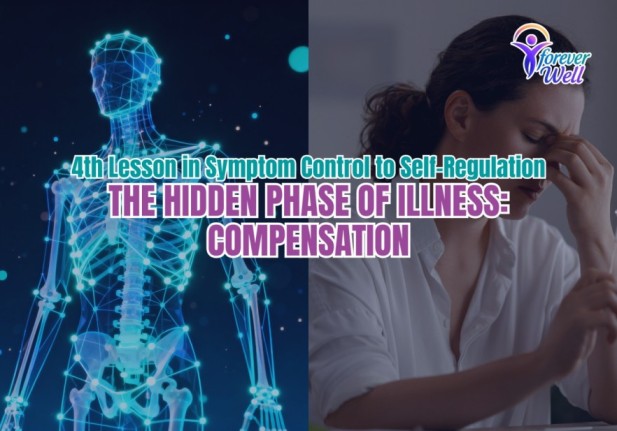
It does not usually arise from a single broken part. It develops slowly, through years of stress, adaptation, compensation, and incomplete recovery across multiple interacting systems.
Its early signs are often vague, intermittent, and difficult to measure. By the time it becomes diagnosable, the body has often been compensating for a long time.
A system designed to identify and fix discrete problems can struggle to recognize, and respond to, this kind of slow, systemic drift.
What This Series Is (and Is Not)
This is not an argument against medicine, doctors, or pharmaceuticals. Symptom relief can be essential. Intervention can be lifesaving. Many treatments are genuinely beneficial.
But relief is not the same as resolution. Symptom relief doesn’t restore health.
This series asks a different set of questions:
- Why do so many treatments need to be taken indefinitely?
- Why do symptoms often migrate rather than resolve?
- Why do people feel unwell long before disease is diagnosable?
- Why does “everything looks normal” so often coexist with diminished vitality?
- What happens inside the body when symptoms are silenced, but causes remain?
These are not fringe questions. They arise directly from lived experience.
A Broader Lens
To explore them, we will gradually widen the lens, from individual symptoms, to adaptation and compensation, to the progression of chronic disease, and finally to the structure of the medical system itself.

Along the way, we will draw on a systems-based understanding of human biology, one that views the body not as a collection of independent parts, but as an integrated, adaptive whole. This perspective does not replace biochemistry or medicine; it completes them.
Why This Matters Now
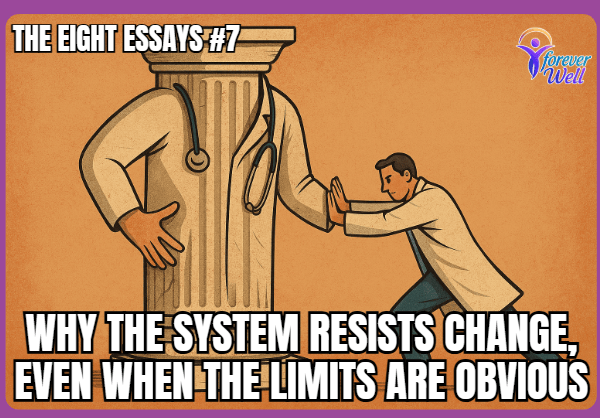
Chronic disease now defines modern healthcare. Managing it indefinitely has become normal. Feeling “stable on medication” is often treated as the endpoint of care.
But stability is not vitality. And survival, while precious, is not the same as health.
If we want a healthcare system that truly restores health, not just controls outcomes, we need to understand why the current model so often falls short, even when it appears to be working.
That is the purpose of this series.
The essays that follow are an invitation to look more carefully at what symptoms are telling us, how the body adapts over time, and why the evolution of healthcare toward a more systems-aware approach is not optional, it is necessary.
Only then can we begin to imagine what a medicine designed for resilience, repair, and long-term vitality might actually look like.
The Myth of “Symptom Control = Health”
Symptoms Series #1: When Symptoms Disappear but Health Is Not Restored
For many people, the modern medical system feels productive and reassuring. Tests are ordered. Results are reviewed. Numbers are discussed. A treatment plan is proposed.
Often, something improves.
Pain decreases. Blood pressure comes down. Cholesterol numbers look better. Blood sugar stabilizes. Anxiety softens. Sleep improves, at least for a time.

And quietly, almost without being questioned, a powerful assumption settles in: If the symptom is controlled, health has been restored.
This essay challenges that assumption, not to dismiss medicine, but to clarify what symptom control can and cannot accomplish, especially in an era dominated by chronic disease.
Relief Is Meaningful, but It Is Not Cure
Let’s begin with a simple, uncomfortable observation:
If a treatment must be taken for the rest of your life, it is almost certainly not curative.
That statement is not a criticism. Many lifelong treatments are protective or lifesaving.
Insulin for Type 1 diabetes is not a failure of medicine, it is a triumph. Blood pressure medications can reduce stroke risk. Other drugs prevent catastrophic outcomes.
But curative interventions resolve an underlying problem. They do not require indefinite suppression to maintain stability.
Today, patients are routinely told, often without much discussion, that they should expect to remain on medications for life:
- Blood pressure drugs
- Cholesterol medications
- Blood sugar regulators
- Acid suppressors
- Antidepressants
- Immune-modulating agents

This expectation has become so normalized that few people stop to ask what it implies. Yet it offers one of the clearest signals that modern healthcare has become extraordinarily good at managing markers, while often falling short of restoring function.
Numbers Improve—but the Person Doesn’t
Many people recognize this disconnect instinctively.
They return for follow-up visits and hear:
- “Your labs look great.”
- “Your numbers are in range.”
- “The medication is doing exactly what it should.”
And yet they still feel:
- Low energy
- Poor sleep
- Reduced resilience
- Brain fog or anxiety
- A lingering sense that something isn’t right

From the system’s perspective, this is success. The measurable targets have been met. From the patient’s perspective, something essential is missing.
This disconnect is not the result of unintelligent doctors, but of a medical system that trained some of our brightest minds to work with an unusually narrow set of tools.
We’ll return to how that happened later in this series.
When Quiet Is Mistaken for Health
Modern healthcare often defines success as silence:
- Symptoms are quieter
- Numbers are normalized
- Risk is reduced
But quiet is not the same as health.
Health is not simply the absence of complaint. It is the presence of vitality, adaptability, and resilience. It is the ability to tolerate stress, recover from illness, and maintain energy over time.
A system can be quiet and still be fragile.
Why This Myth Persists
The myth of symptom control persists not because doctors are careless or unthinking, but because the medical system rewards what is:
- Measurable
- Standardized
- Defensible
- Actionable
Symptoms are subjective. Numbers are objective. And so numbers become the proxy for health, even when they fail to reflect lived reality.
This is not a moral failure. It is a structural one.
Why This Series Begins Here
This essay opens the series because it names a shared experience before offering explanations.
Many people sense, without being able to articulate it, that something about modern healthcare feels incomplete. This is that feeling, named.

Later essays will explore why symptom control so often fails to restore health, what happens inside the body when symptoms are silenced, but causes remain unresolved, and how the medical system evolved in ways that make this outcome predictable rather than surprising.
For now, it is enough to recognize this:
Symptom relief has value. Sometimes it is essential.
But when relief becomes the destination rather than the doorway, we mistake quiet for healing.
And once that distinction is clear, a much deeper conversation can finally begin.