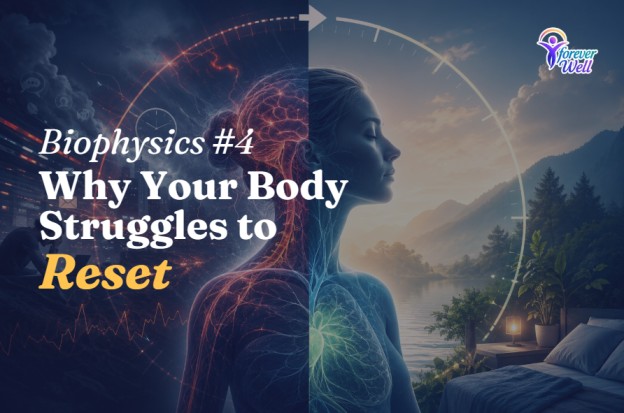
Chronic Stress and Recovery: Why Your Body Struggles to Reset
In Part 3, we explored a radically expanded view of the human organism.
Not as isolated organs functioning independently, but as a continuous, electrically coordinated system maintained through structured communication across the body.
We explored:
- structured water
- liquid crystalline organization
- connective tissue continuity
- the living matrix
- and the interstitium as part of an interconnected communication network increasingly recognized within mainstream anatomical research
Together, these discoveries point toward a profound realization: Health depends on coherence.
The organism functions properly when communication remains organized, signals remain coordinated, and the body maintains the ability to adapt continuously to changing conditions.
But coherence is not static. It is rhythmic.
Life Depends on Rhythm
Living systems are not designed for endless activation.
They function through cycles: activation and recovery, stress and repair, exertion and restoration.
The heartbeat follows rhythm. Breathing follows rhythm. Hormones fluctuate rhythmically. Sleep and wakefulness follow circadian rhythm. Digestion follows rhythm. Cellular repair follows rhythm.
Health does not require the absence of stress.
Health requires the ability to respond to stress appropriately and then return to balance afterward.
This ability to recover is one of the defining characteristics of a healthy organism. A healthy system is flexible. It can activate when necessary, recover when the challenge passes, and restore coordinated function once again.
Problems begin when activation becomes chronic and recovery becomes incomplete.
Stress Is Biological Demand
Stress is often misunderstood as primarily emotional.
But biologically, stress simply means: demand placed upon the organism.
Those demands can come from many directions: poor sleep, nutritional deficiency, chronic inflammation, environmental burden, psychological strain, circadian disruption, social isolation, persistent uncertainty. The organism responds to all of these physiologically.
And because the body functions as an integrated system, stress in one area inevitably influences others.
This is why prolonged stress affects energy, digestion, sleep, mood, immune regulation, and cognitive function simultaneously.
The organism reorganizes itself around survival.
The Cost of Continuous Activation
The stress response itself is not the problem. It is one of the most remarkable survival systems in biology.
When danger appears, the organism rapidly shifts resources toward immediate survival: heart rate changes, focus narrows, stress hormones rise, digestion slows, and repair processes are temporarily deprioritized.
In short bursts, this response is protective.
But modern life increasingly keeps the organism in a state of ongoing partial activation. Artificial light extends stimulation deep into the night. Constant digital engagement fragments attention and recovery. Environmental pressures remain continuous.

Many people move from one demand to another without ever fully returning to physiological rest.
The body remains alert long after the original stressor should have passed. Over time, this alters regulatory function across the organism. Sleep becomes less restorative. Inflammatory signaling increases.
Hormonal rhythms become disrupted. The nervous system loses flexibility. Recovery slows. The organism gradually loses coherence.
Recovery Is Not Passive
One of the most important misunderstandings in modern culture is the idea that recovery is simply “doing nothing.”
Biologically, recovery is an active process.
During sleep and restorative states, the organism reorganizes itself: damaged tissues are repaired, metabolic waste is cleared, immune signaling is recalibrated, memory is consolidated, energy systems are restored, and nervous system balance is reestablished.

The body shifts into a state optimized for repair and restoration.
The parasympathetic nervous system plays a central role in this process. Often called the “rest and repair” state, it supports healing, digestion, recovery, and long-term regulatory balance.
But modern life increasingly interrupts these natural cycles. People sleep, but do not fully recover. Rest, but remain internally activated. Pause physically, while remaining neurologically overstimulated.
The organism loses its natural oscillation between activation and restoration. And without rhythmic recovery, coherence begins to degrade.
Loss of Coherence
When coherence declines, dysfunction rarely appears all at once.
The changes are often gradual: reduced resilience, slower recovery, persistent fatigue, sleep disruption, digestive instability, brain fog, heightened stress sensitivity, and chronic inflammation.
Many people experience these shifts for years before developing a formal diagnosis.
This matters because chronic illness increasingly appears not simply as malfunction of isolated parts, but as breakdown in coordinated regulation across the organism.
The body is no longer adapting efficiently. Communication becomes less organized. Recovery becomes less complete. Regulation becomes less stable. The organism loses flexibility.
Why Chronic Illness Spreads Across Systems
This helps explain why chronic illness rarely remains confined to a single symptom or organ system.
People struggling with chronic dysfunction often experience disturbances in many areas simultaneously: sleep, digestion, mood, energy, immune regulation, and cognition.
Within a reductionist framework, these symptoms are often treated as unrelated.
But within a coordinated biological system, they are deeply connected.
When regulation degrades in one part of the system, the effects ripple across the whole organism.
Because the body does not function as isolated compartments. It functions as an integrated network continuously attempting to maintain coherence under changing conditions.
The Modern Loss of Biological Rhythm
Human physiology evolved within natural cycles: light and darkness, movement and rest, activity and recovery.
Modern life disrupted many of those rhythms simultaneously. Artificial light altered circadian signaling. Ultra-processed foods distorted metabolic regulation. Sedentary living reduced physiological adaptability. Constant stimulation weakened restorative cycles.
The organism is now being asked to regulate itself under conditions that continuously interfere with recovery.
And because recovery is essential to coherent regulation, the consequences spread system-wide.
The body is not harmed by stress alone. It is harmed by stress without sufficient restoration.

A Different Understanding of Health
Within a reductionist framework, health is often defined primarily through symptom management and laboratory measurements.
But from the perspective of systems biology and biophysics, health looks different.
Health reflects the organism’s ability to: adapt, recover, self-regulate, and maintain coherence across changing conditions.
And disease appears not simply as malfunction of isolated parts, but as loss of organized communication and rhythmic regulation across the system itself.
This does not make symptoms unimportant.
Symptoms are signals. Messages that the organism is struggling to maintain balance under accumulated physiological load.
The Organism Wants to Heal
Living systems continuously move toward repair and restoration whenever conditions allow.
The body is not working against us. It is constantly attempting to: adapt, recover, reorganize, and restore coherence.
Which means the future of healthcare depends less on overriding isolated symptoms and more on restoring the conditions that allow coherent regulation to emerge naturally once again.
Because health is not static. It is rhythmic, adaptive, dynamic, and continuously renewed through cycles of recovery.
In Part 5, we will explore why modern medicine often struggles with chronic illness within a reductionist framework and why restoring coherent function requires expanding the model itself.