BIOPHYSICS 3
In Part 2, we explored the body as an electrical organism. Every cell maintains electrical charge. Signals move continuously across tissues. The organism coordinates itself in real time through ongoing communication across the whole system.
But electrical systems require more than electrical activity alone. They require:
- structure
- organization
- conductivity
- and a medium through which communication can occur
This raises a critical question: What physical structure allows the body to function as a coordinated whole?
Because communication does not occur in abstraction. It requires architecture.
The Missing Piece in Biology
For generations, biology focused primarily on chemistry: molecules, enzymes, receptors, pathways.
But chemistry alone does not explain organization. Chemical reactions do not coordinate themselves. A living organism is not merely a collection of reactions taking place randomly inside fluid-filled compartments. It is an organized system capable of maintaining coherence across trillions of cells simultaneously.

That level of organization requires a physical framework capable of:
- transmitting information
- distributing energy
- coordinating signals
- and integrating function across the entire organism
This is where modern biophysics begins to fundamentally expand our understanding of life.
Water: More Than a Passive Solvent
We have long been taught that water is important primarily because:
- it dissolves substances
- transports nutrients
- regulates temperature
- maintains hydration
But the work of Gerald Pollack, PhD, Professor of Bioengineering at the University of Washington, revealed that water inside living systems behaves very differently than previously believed.
Under biological conditions, water organizes itself into structured layers along hydrophilic surfaces such as:
- proteins
- membranes
- connective tissue
- cellular structures
Pollack described this organized state as a distinct phase of water, sometimes referred to as the “fourth phase.”
This structured water behaves differently from ordinary bulk water. It:
- separates electrical charge
- stores energy
- conducts signals
- organizes molecular interactions
- and forms highly ordered layers throughout living tissues
This changes how we think about biology itself. Water is not simply surrounding the system. It is participating in the system.

The Importance of Structure
To understand why this matters, think about the difference between: a pile of bricks and a cathedral. The materials may be similar. The organization is not. Structure determines function.
This principle exists throughout nature. A crystal is highly ordered. Its molecules align in organized patterns that allow stability and coherence. A liquid flows freely and adapts continuously. Living systems appear to possess qualities of both.
This was one of the central insights of Mae-Wan Ho, PhD, biophysicist and geneticist, former Reader in Biology at The Open University in the United Kingdom and author of The Rainbow and the Worm.
Dr. Ho proposed that living organisms exist in a liquid crystalline state: organized enough to coordinate, flexible enough to adapt.
This liquid crystalline organization helps explain how the organism can maintain:
- rapid communication
- coordinated signaling
- flexibility
- adaptability
- and system-wide coherence simultaneously
The body is not rigid. But neither is it disorganized. It is structured, dynamic, and continuously responsive.
The Living Matrix
Once structured water and liquid crystalline organization are understood together, a larger picture begins to emerge.
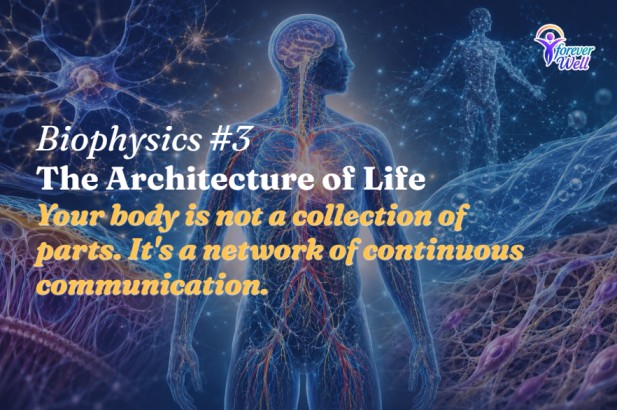
The body contains a continuous internal network formed through:
- connective tissue
- fascia
- cellular cytoskeletons
- membranes
- extracellular matrix
- and structured water itself
Rather than isolated components, these structures form an interconnected biological fabric extending throughout the organism. Some researchers refer to this as the living matrix.
This matrix is:
- continuous
- conductive
- responsive
- and mechanically interconnected across the body
Signals do not simply travel through nerves alone. Mechanical tension, electrical charge, fluid movement, and structural changes all influence communication across this integrated network. The organism behaves as a coordinated whole because it is physically organized as a coordinated whole.
The Interstitium and the Evolution of Anatomy
This broader understanding is now being reinforced by emerging anatomical research.
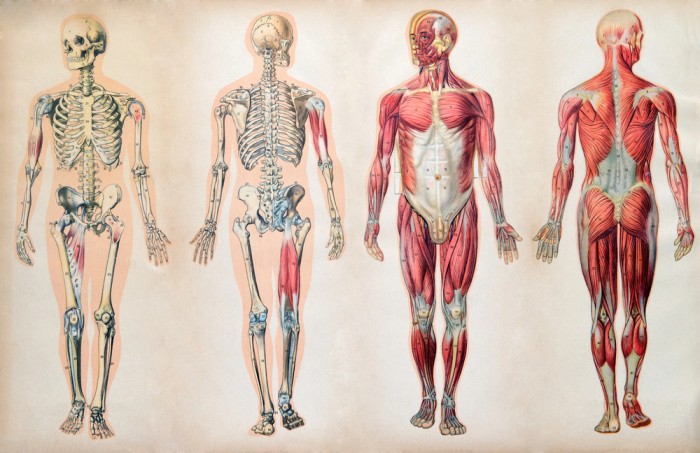
Neil Theise, MD, Professor of Pathology at NYU Grossman School of Medicine, and Rebecca Wells, MD, Professor of Medicine at the University of Pennsylvania, have helped draw attention to the importance of the interstitium: a continuous network of fluid-filled connective tissue spaces extending throughout the body.
For many years, these spaces were largely overlooked or treated as passive structural background.
But growing research suggests the interstitium may function as a body-wide communication and transport network influencing:
- fluid movement
- mechanical signaling
- immune activity
- tissue coordination
- and organism-wide regulation
This research is important not because it overturns biology, but because it expands it. It reflects the continuing evolution of mainstream scientific understanding toward seeing the body less as isolated parts and more as an integrated, continuously communicating system.
Interestingly, some researchers have noted overlap between connective tissue pathways and regions long emphasized in traditional Chinese medicine. The significance of this is not that ancient systems possessed modern scientific explanations.
It is that modern anatomy may now be identifying physical communication networks that earlier medical traditions observed functionally long before modern imaging technologies existed.
Why This Changes Everything
Once the organism is understood as a continuous conductive network, many observations begin to make more sense. The speed of whole-body coordination. The rapid shifts between stress and recovery states.
The systemic effects of sleep, movement, stress, hydration, and nutrition. The way local dysfunction can influence distant systems.
The organism no longer appears as separate systems somehow trying to cooperate. It appears as one integrated system expressing itself through many interconnected functions.
And this has profound implications for how we think about health and disease.
Because if communication depends on:
- structure
- conductivity
- organization
- fluid dynamics
- and coherent signaling
then disruptions in those conditions affect the organism system-wide.
The problem is no longer simply chemistry. It becomes:
- disorganization
- impaired signaling
- degraded coordination
- and loss of coherence across the system itself

A Different View of the Human Organism
At this level, the body begins to look less like a machine assembled from separate parts and more like a living field of continuous communication. Electrical, mechanical, chemical, structural, and energetic processes are all interacting simultaneously across the same integrated architecture.
This does not replace biochemistry. It places biochemistry inside a larger organizational framework. The organism is not only reacting chemically. It is coordinating structurally.
And once this becomes visible, another question naturally emerges: If the body depends on coherence to maintain function, what happens when that coherence begins to break down?
That is where we now turn.
In Part 4, we will explore how modern life disrupts coherence through stress, poor nutrition, environmental exposures, circadian disruption, and chronic physiological load — and why those disruptions often manifest across the entire organism rather than in isolated parts alone.