Introduction to the Series
In our previous series, The Eight Essays, the series on those born in the 1980s and 1990s, and most recently 10 Lessons on Symptom Control to Self-Regulation, we explored a growing realization emerging from modern scientific research:
The human organism cannot be fully understood as a collection of isolated parts.
For more than a century, modern medicine has largely approached the body through a reductionist model:
- the heart separated from the lungs,
- the digestive system separated from the immune system,
- the brain separated from the rest of the organism.
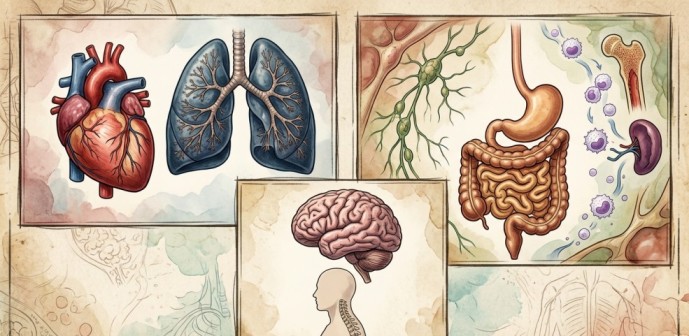
But living systems do not actually function this way.
The systems of the body are continuously communicating and adapting in real time.
This broader understanding gave rise to Systems Biology:
the study of how living organisms function through interconnected regulatory networks rather than isolated mechanisms.
But this raises an even deeper question.
If the body truly functions as an integrated whole,
how does that coordination actually occur?
If the body truly functions as an integrated whole, how does that coordination actually occur? How do distant systems communicate so rapidly? How does the organism maintain coherence across trillions of cells? How can the state of the whole body shift almost instantly under stress, danger, emotion, or environmental change?
Biochemistry alone does not fully explain this level of organization.
Chemistry matters profoundly. But chemistry requires something more fundamental: a structure, a medium, and a system capable of distributing energy and information across the organism in real time.
This brings us to the other side of biology: Biophysics.
While modern medicine remained heavily centered on biochemistry, another field advanced in parallel. Biophysicists have been investigating the physical organization of living systems — how energy is formed, distributed, stored, transmitted, and coordinated throughout the body. The biophysics of the human body is, in many ways, the science that medicine left behind.
Among the most important researchers in this area is Mae-Wan Ho, PhD, biophysicist and geneticist, former Reader in Biology at The Open University in the United Kingdom, and author of The Rainbow and the Worm.
Dr. Ho proposed that the living organism functions not as a random collection of tissues and fluids, but as a highly ordered, coherent, liquid crystalline system capable of rapid, system-wide communication.
Equally important is the work of Gerald Pollack, PhD, Professor of Bioengineering at the University of Washington and author of The Fourth Phase of Water and Cells, Gels and the Engines of Life.
Pollack’s work challenged one of the most overlooked assumptions in biology:
that water inside the body is merely passive background chemistry.
For decades, scientific research largely treated water as a simple solvent, important but unremarkable.
As Pollack himself explains, few researchers focused deeply on water precisely because it appeared too ordinary to matter.
But his research revealed something extraordinary:
water within living systems behaves differently than previously believed.
Rather than acting as a passive fluid, water forms structured, electrically active layers that play a central role in:
- energy storage;
- charge distribution;
- signal transmission; and
- biological organization itself.
In many ways, Pollack’s work builds upon earlier insights from researchers such as Gilbert Ling, MD, PhD, who questioned the long-standing assumption that the cell functions merely as a bag of fluid surrounded by a membrane.
Together, this research points toward a radically expanded understanding of the living organism.
In this series, we will explore:
- the body as an electrical and energetic system
- the role of liquid crystalline water and structured biological organization
- how energy and information move throughout the organism
- how coherence is maintained across systems
- why chronic illness reflects breakdowns in regulation and communication
- and why modern medicine, built primarily around biochemical intervention, often struggles to restore chronic disease to proper regulatory balance
We will explore how the body functions not as isolated parts, but as a coordinated whole. A dynamic system maintained through continuous communication across every level of the organism.
Health is what it looks like when every cell in the body is, in a sense, singing the same song…in tune.
This series is about the science that is beginning to explain how that happens.
So sit back and enjoy. You are about to explore one of the most fascinating frontiers in modern scientific understanding: the emerging science of how living systems organize, communicate, adapt, and maintain coherence as integrated wholes.
BIOPHYSICS 1
Why Biophysics Matters
For more than a century, modern medicine has approached the human body primarily through the lens of biochemistry.
We have learned to identify:
- hormones
- neurotransmitters
- enzymes
- inflammatory molecules
- genes
- receptors
- metabolic pathways
And this approach has profoundly shaped how we think about health and disease. The body became increasingly understood by separating it into parts. One doctor studies the heart. Another the digestive system. Another the immune system. Another the brain.
But living organisms do not actually function this way.
The systems of the body are continuously communicating. The digestive system influences immune behavior. The nervous system alters hormonal signaling. Stress changes inflammation. Sleep affects metabolism. Emotions influence physiology. Everything is connected through ongoing communication across the organism.
This realization led to the field known as Systems Biology: the study of how living systems function through interconnected regulatory networks rather than isolated mechanisms.
And once you begin seeing the organism this way, an even deeper question naturally emerges:
How does this level of coordination actually happen? How can distant systems within the body respond almost instantly to stress, danger, emotion, movement, or environmental change? How does the body function as a unified whole rather than a collection of separate parts?
Because for the organism to behave this way, communication must be occurring continuously across the system. And that communication happens far too rapidly and far too broadly to be explained entirely through slow biochemical reactions moving randomly through fluids.
This is where another field enters the picture: Biophysics.
The Other Side of Biology
For decades, biology has been dominated by chemistry. But chemistry alone cannot explain organization.
Chemistry requires:
- structure
- timing
- coordination
- energy
- cell communication
A living organism is not simply a pile of molecules reacting in isolation. It is an organized system. And organized systems require something capable of maintaining that organization.
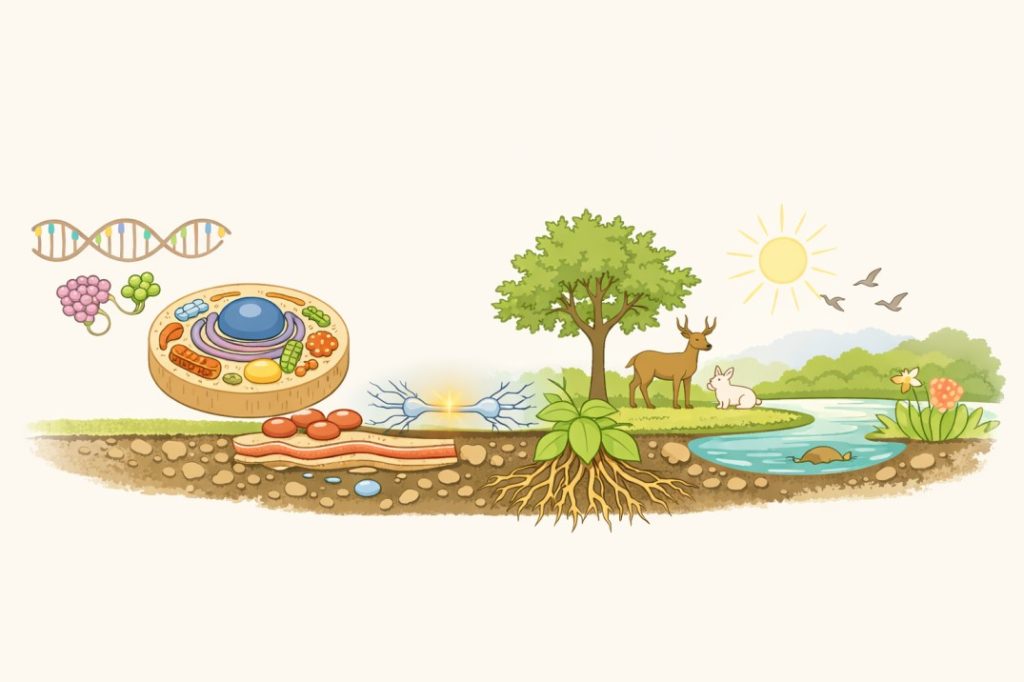
This is the focus of biophysics: the study of how physical forces, energy, electrical activity, structure, and information flow shape living systems.
While the public conversation about biology remained heavily centered on chemistry, biophysicists were asking a different question:
What physical structures allow living systems to behave as integrated wholes?
That question has opened an entirely new understanding of living systems.
The Body Is Not Just Chemical
We already recognize many electrical aspects of the body in everyday medicine.
- The heart operates through electrical conduction.
- The brain functions through electrical signaling.
- Muscles contract through electrical activation.
- Every cell maintains an electrical charge across its membrane.
This is not alternative science. It is standard physiology.
Without electrical gradients:
- nerves cannot fire
- muscles cannot contract
- cells cannot regulate themselves
- communication breaks down
Electricity is not secondary to biology. It is fundamental to it.
What Electrical Systems Require
But electrical systems require more than charge alone. They require:
- conductive structure
- organization
- a medium through which energy and information can move
Which brings us to one of the most overlooked subjects in biology: Water.
The Most Ignored Substance in Biology
At first glance, water seems too ordinary to deserve much attention. We are taught that the body is mostly water. But beyond hydration, most people rarely think about it again.
Even within science, water was historically treated largely as background: a passive solvent in which the “important” chemistry occurred.
Gerald Pollack, PhD, Professor of Bioengineering at the University of Washington and author of The Fourth Phase of Water and Cells, Gels and the Engines of Life, has explained that few researchers devoted their careers to studying water precisely because it appeared too simple and too familiar to matter.
But that assumption was profoundly mistaken.
What Makes Water Different Inside the Body
Pollack’s research helped reveal that water inside living systems does not behave like ordinary bulk water sitting in a glass. Under biological conditions, water becomes structured. It forms organized layers along biological surfaces:
- proteins
- membranes
- connective tissues
- cellular structures
Properties of Structured Water in Living Systems
These structured layers possess unusual properties.
They:
• hold electrical charge
• create separation of charge
• store energy
• influence signal transmission
• participate in organization across tissues

In other words:
Water does not merely support life chemically.
It participates directly in the body’s communication and organizational system.
This idea did not emerge from nowhere. Pollack’s work builds in part upon earlier researchers such as Gilbert Ling, MD, PhD, who challenged the long-standing assumption that cells function simply as membrane-bound bags of fluid.
Ling proposed that water inside living systems exists in a more ordered state than previously recognized, interacting continuously with proteins and cellular structure.
Modern biophysics is now revisiting many of these earlier insights.
The Work of Mae-Wan Ho
Another major figure in this emerging understanding is Mae-Wan Ho, PhD, biophysicist, geneticist, former Reader in Biology at The Open University in the United Kingdom, and author of The Rainbow and the Worm.
Dr. Ho proposed that living organisms function as highly ordered, coherent systems organized through what she described as liquid crystalline structure.
That phrase may sound technical, but the underlying idea is remarkably intuitive.
- A crystal is organized.
- A liquid flows.
- Living systems appear to possess qualities of both: organized enough to coordinate, flexible enough to adapt.
Ho proposed that this liquid crystalline organization allows rapid communication across the organism, helping explain how the body functions as an integrated whole.
The body, in this view, is not simply biochemical. It is:
- electrical
- structural
- energetic
- informational
- dynamic
And once this perspective is understood, many things begin to look different.
A Different Way to Think About Chronic Illness
Modern medicine generally approaches chronic disease by identifying and modifying pathways.
- Lower blood sugar.
- Suppress inflammation.
- Block acid production.
- Alter neurotransmitters.
- Reduce cholesterol.
And these interventions can absolutely change measurable outcomes.
But an important distinction becomes visible: changing a pathway is not the same as restoring coordinated function across the system.
Because chronic illness rarely involves only one pathway.
It reflects disturbances across interconnected regulatory networks:
- metabolic
- neurological
- hormonal
- immune
- digestive
Which helps explain why so many chronic conditions produce similar experiences:
- fatigue
- inflammation
- poor resilience
- sleep disruption
- digestive dysfunction
- mood changes
- cognitive fog
Different diagnoses.
Similar patterns of dysregulation.
The organism behaves as a whole because it functions as a whole.

And once that becomes visible, the limitations of a purely reductionist model become easier to understand.
What This Series Will Explore
In this series, we are going to explore a very different way of understanding the human organism. Not as a machine assembled from separate parts. But as a dynamic, electrically coordinated system maintained through continuous communication across the whole body.
We will explore:
- the body as an electrical organism
- the role of structured water and liquid crystalline organization
- how energy and information move through living systems
- how coherence is maintained
- how modern life disrupts that coherence
- and why restoring health depends less on overriding symptoms and more on restoring the conditions required for coordinated function
This does not mean biochemistry is wrong. It means biology is bigger than biochemistry alone.
The human organism is not merely chemical. It is an organized, dynamic system where structure, energy, signaling, and communication continuously interact to maintain coherence across the whole.
As we have said before:
“Health is what it looks like when every cell in the body is, in a sense, singing the same song…in tune.”
— Tom Staverosky · Biophysics of the Human Body
Biophysics is beginning to explain how that happens.