
Why the Medical System Wasn’t Built for Chronic Illness
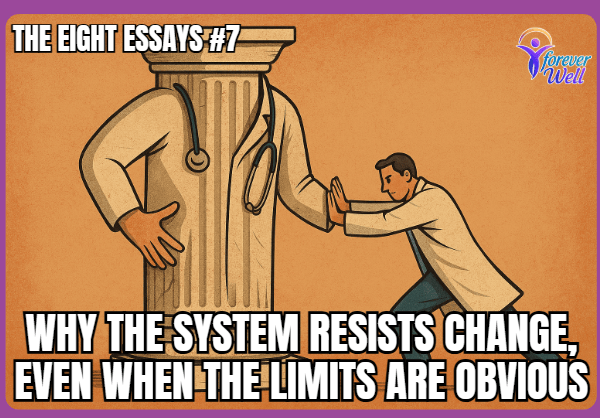
What if the problem isn’t that medicine is failing chronic illness—but that it was never designed to treat it in the first place?
By this point in the series, a pattern should be clear.
Chronic illness rarely arrives suddenly. It develops over time, through stress, adaptation, compensation, and incomplete recovery. Symptoms migrate. Resilience erodes. Diagnosis often comes late—after years of quiet imbalance.
So an obvious question follows:
If this is how chronic disease actually develops, why does our healthcare system struggle so much to address it?
The answer is not incompetence, indifference, or lack of intelligence. It is something far more structural.
A System Designed for a Different Era
Modern medicine was not designed around chronic illness. It was forged in response to acute threats.
In the late nineteenth and early twentieth centuries, the dominant medical challenges were:
- Trauma and injury
- Childbirth complications
- Acute infections
- Surgical emergencies
- Organ failure
In that context, medicine evolved brilliantly. The prevailing logic was clear:
- Identify the problem
- Isolate it
- Intervene decisively
- Stabilize the patient
This approach saved millions of lives. It still does.
But chronic illness is not an acute event. It is a process—slow, adaptive, and systemic. A system optimized for crisis intervention is poorly suited for biological drift that unfolds over years or decades.

How Doctors Are Trained to Think
Medical training reflects this history.
Physicians are taught to:
- Recognize patterns that match known diseases
- Rule out dangerous conditions quickly
- Identify abnormalities that require action
- Choose interventions—most often pharmaceutical—with predictable effects
This is not narrow-mindedness. It is survival logic.
This way of thinking is essential in acute care. Its limitations only become visible when illness unfolds slowly, across systems, and over time.
Chronic illness asks different questions:
- Why is this system struggling to regulate?
- What adaptive capacity has been exceeded?
- What conditions no longer support balance?
- What would allow recovery to begin?
These are system questions. They do not lend themselves easily to rapid diagnosis, discrete interventions, or standardized protocols.
The Language Reveals the Limitation

We can see this limitation reflected in the language medicine uses.
We call these conditions chronic.
“Chronic” does not describe the cause.
It does not describe the mechanism.
It does not describe resolution.
It describes duration.
The label itself quietly signals an expectation of persistence rather than restoration.
When a condition is named for how long it lasts rather than how it resolves, management becomes the implicit goal.
This isn’t a moral failing. It’s a linguistic clue to the boundaries of the model.
The Power—and the Limits—of the Pharmaceutical Toolset
Pharmaceuticals are powerful tools. They are:
- Targeted
- Measurable
- Scalable
- Predictable
- Testable in controlled trials
They work exceptionally well when:
- A single pathway is driving the problem
- A specific mechanism needs to be modulated
- Short-term stabilization is required
This makes them indispensable in acute care and valuable in risk reduction.
But chronic illness rarely lives in a single pathway. It emerges from interactions across multiple systems—metabolic, immune, neurological, hormonal, gastrointestinal, and environmental.
Here the limits of a narrow toolkit become visible.
A system built around pharmaceuticals and procedures will naturally favor those solutions, even when the problem demands something broader. When the toolkit is narrow, even the brightest clinicians are forced to practice within its limits.

This is not a critique of doctors. It is a description of constraint.
Reductionism vs. Systems Reality
The medical system is structured to think in terms of:
- Parts
- Targets
- Pathways
- Diagnoses
- Interventions
The human body behaves as:
- A network
- A set of feedback loops
- A constantly adapting whole
- A balance of competing demands
When these two perspectives meet, friction is inevitable.
Reductionism is not wrong—it is incomplete. It excels when a single variable dominates. It struggles when disease emerges from relationships between systems rather than failures within one.
Chronic illness exposes that gap.
Time: The Missing Ingredient
Chronic disease unfolds slowly. Restoration does too.
Yet modern healthcare is built around:
- Short visits
- Discrete complaints
- Billable interventions
- Measurable outputs
There is little structural space for:
- Longitudinal pattern recognition
- Environmental assessment
- Lifestyle reconstruction
- Incremental restoration of resilience
When time is scarce, care naturally gravitates toward what can be done quickly, documented clearly, and reimbursed reliably.

How “Management” Became Normal
None of this was planned.
As chronic illness became more common, medicine responded with the tools it had:
- Suppress symptoms
- Control markers
- Reduce risk
- Prevent catastrophe
Over time, this approach became normalized.
“Stable on medication” replaced “restored to health.”
Management replaced resolution.
Maintenance replaced recovery.
This was not conspiracy. It was adaptation—on the part of the medical system itself.
The Human Cost of Structural Limits
For patients, this often feels like:
- Being monitored rather than healed
- Being managed rather than understood
- Being stabilized rather than restored
For clinicians, it can feel like:
- Treating the same conditions endlessly
- Seeing improvement without recovery
- Working hard inside a model that never quite resolves the problem
Both sides feel the strain.
Evolution, Not Rejection
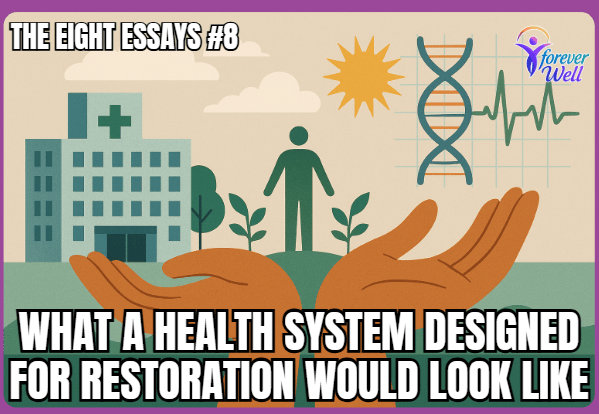
This is not an argument to abandon modern medicine. It is an argument to complete it.
Acute care saves lives.
Pharmaceuticals have real value.
Diagnostics are essential.
But chronic illness demands an expanded framework—one that can:
- Track adaptation over time
- Recognize early imbalance
- Support the body’s inherent balancing mechanisms
- Restore resilience rather than merely control outcomes
That requires systems-level thinking, longer horizons, and a broader definition of success.
It also raises a new and unavoidable question—one medicine has not traditionally asked:
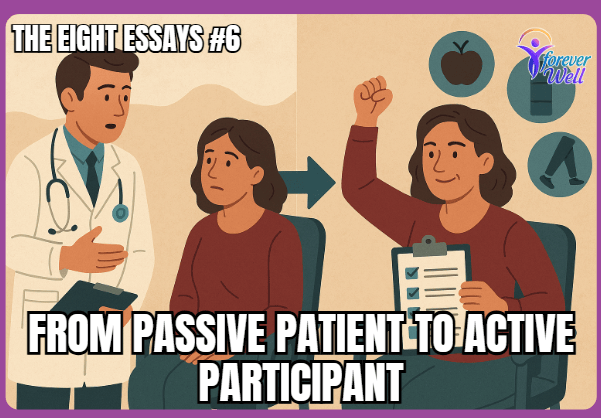
If no single intervention can do the work alone, what role do clinicians and patients each play in recovery?

Looking Ahead
In the next essay, we’ll explore that question directly—how responsibility, agency, and participation quietly shifted as chronic illness replaced acute disease, and why this shift can feel both empowering and overwhelming.
For now, this much is clear:
Modern medicine excels at crisis.
It performs well with infection.
It struggles with chronic illness not because it lacks intelligence—but because it was never designed for conditions that unfold slowly, systemically, and adaptively.
Recognizing that limitation is not an attack.
It is the first step toward evolution.