By now, the biology should be clear. Chronic illness develops over time.
Symptoms are signals, not defects. Suppression changes expression, not cause.
Participation matters. Restoration depends on conditions, not just interventions.
And yet the dominant healthcare model remains largely unchanged.
If patients, clinicians, and researchers increasingly recognize the limits of a pharmaceutical-centric approach to chronic illness, a reasonable question follows:
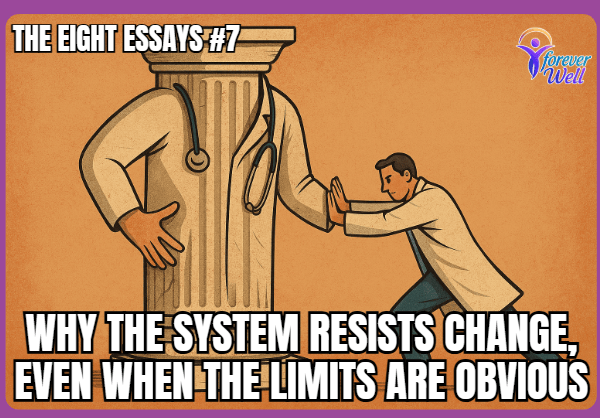
Why hasn’t the system evolved?
The answer is not ignorance, indifference, or bad intent. It is something far more structural and far more difficult to change.
Systems Don’t Persist Because They’re Right
They Persist Because They’re Reinforced
Once established, complex systems don’t need defenders.
They defend themselves.
This requires no conspiracy or coordination. The structure of the system quietly rewards certain behaviors and discourages others. People act rationally within those constraints, and the system maintains itself, even when outcomes fall short.
Healthcare is no exception.
What persists is not what restores health most reliably, but what is:
- Measurable
- Scalable
- Reimbursable
- Defensible
- predictable

Chronic illness exposes the cost of this bias.
The Research Funnel Shapes the Questions We Ask
Most people assume medical science studies the most important questions first. In practice, research often follows what can be funded.
Drug development fits neatly into the dominant research model:
- isolate a target
- manipulate one variable
- measure a short-term endpoint
- publish reproducible results
Systems-level interventions, dietary pattern change, stress reduction, sleep restoration, environmental load reduction, do not fit as cleanly.
They are:
- Multi-variable
- Individualized
- slow to standardize
- difficult to patent
- harder to isolate in trials
As a result, the scientific literature becomes dense where funding flows and thin where complexity lives.

This does not mean non-pharmaceutical approaches lack value. It means they are harder to study using methods designed for isolated variables.
Guidelines Follow Evidence, But Evidence Follows Structure
Clinical guidelines are designed to protect patients and clinicians. They rely on evidence hierarchies that prioritize randomized controlled trials and large population studies.
That approach works exceptionally well for drugs and procedures. It works less well for:
- Nutrition
- Sleep
- stress physiology
- microbiome dynamics
- movement patterns
- cumulative environmental exposure
When guidelines depend on evidence that is expensive to generate and easy to quantify, the outcome is predictable:
The system gravitates toward what it can prove easily, not what it can support patiently.
Support, in this context, means creating and sustaining conditions over time while the body restores balance, often through nonlinear, individualized processes that resist short timelines and clean endpoints.
When the right conditions are restored, the body often responds far more quickly than expected, even though rebuilding deeper resilience may take longer.

Those rapid early improvements are real and clinically observable. What unfolds more slowly is the rebuilding of reserve, flexibility, and long-term stability, processes that do not conform well to institutional timelines or billing cycles.
Reimbursement Shapes Practice
What gets reimbursed gets practiced.
Healthcare systems are built to:
- pay for visits
- code diagnoses
- bill procedures
- reimburse prescriptions
They are not built to:
- reward extended listening
- support longitudinal coaching
- fund iterative self-observation
- invest in prevention whose payoff arrives years later
When visits are brief and documentation is rigid, the system has already narrowed the available tools.
Even clinicians who recognize the limits of the model must practice within it.
When a Tool Appears, Older Knowledge Quietly Disappears
Before modern diabetes drugs existed, physicians routinely advised patients with early type 2 diabetes to reduce sugars and refined carbohydrates. The logic was straightforward, and the results were often meaningful.
With the introduction of widely used medications like metformin, blood sugar could now be lowered reliably and predictably, without requiring sustained changes in diet or daily habits.
When asked years later whether carbohydrate restriction still works, most clinicians nod without hesitation.
It hasn’t stopped working.
What changed was not biology, but reliance on a new tool—one that fit more cleanly into research models, clinical guidelines, and reimbursement structures.
When a pharmaceutical solution becomes available, behavior-based approaches are often displaced, not because they failed, but because the system reorganized around what was easier to deliver, measure, and defend.
This pattern repeats across chronic disease.
Risk Management Slowly Replaces Restoration
Modern medicine is rightly cautious. Liability matters. Predictability matters. Avoiding harm matters.
But risk management is not the same as restoring health.
Lowering blood sugar reduces risk.
Reducing cholesterol modifies probability.
Suppressing inflammation can prevent crisis.
None of these necessarily rebuild resilience.

Over time, success becomes defined as:
- numbers in range
- symptoms controlled
- disease “managed”
- patients “stable”
That is a form of success, but it is not the same as vitality, adaptability, or balance.
Why Change Feels Threatening, Even When It’s Needed
Expanding beyond a pharmaceutical-centric model introduces:
- Uncertainty
- Variability
- longer time horizons
- shared responsibility
- outcomes that are harder to standardize
It requires:
- broader training
- more time per patient
- tolerance for individuality
- collaboration rather than command
These shifts challenge deeply embedded assumptions about expertise, control, and efficiency.
Systems resist not because they are malicious, but because redesign is costly, and stability is rewarded.
This Is Not Obstruction, It’s Alignment
It is tempting to frame this resistance as obstruction by bad actors. That framing is emotionally satisfying, and largely incorrect.
What we are seeing is alignment:
- incentives align with interventions
- evidence aligns with funding
- guidelines align with research
- reimbursement aligns with documentation
Once aligned, systems move predictably, even when outcomes disappoint.
Chronic illness persists not because no one cares, but because the system is optimized for management rather than restoration.
What This Understanding Changes for Patients
Seen through this lens, many patient experiences make sense.
If health is not fully restored:
- it is not because you failed
- it is not because you didn’t comply well enough
- it is not because your symptoms lack legitimacy
It is because the system was never designed to do what chronic illness requires.

That realization can be sobering, but it can also be freeing.
Evolution Requires Clarity
Healthcare systems do evolve. They always have.
But evolution begins with honesty:
- about what works well
- about what works poorly
- about what is rewarded
- about what is missing
Recognizing the limits of a pharmaceutical-centric model is not anti-medicine. It is a prerequisite for maturity.
Looking Ahead
In the final essay of this series, we step forward rather than critique backward.
What would a healthcare system designed for restoration look like?
What tools would it value?
How would clinicians and patients collaborate?
How would success be defined?
If chronic illness is the defining health challenge of our time, evolution is not optional.
The question is not whether the system must change, but whether we are willing to see clearly what keeps it exactly as it is.