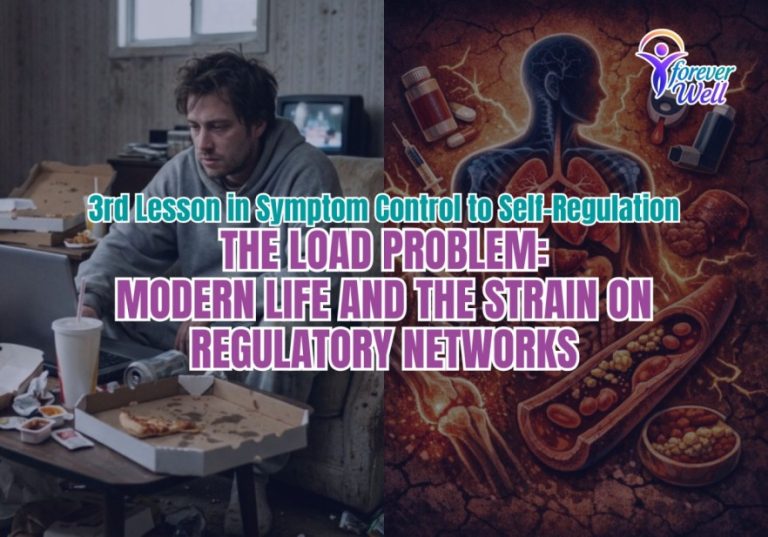

What if the human body is not a collection of parts, but a coordinated system designed to maintain balance?
In the previous lesson we explored an important architectural problem in modern health care. The medical system that cares for us today was largely designed to identify and interrupt acute threats.

That model has produced extraordinary successes in trauma care, infectious disease, and emergency medicine.
But chronic disease operates differently.
If chronic illness often reflects disturbances in the body’s regulatory networks rather than a single identifiable threat, a natural question follows:
How does the organism normally maintain health?
To answer that question, we must step back and look at the human body in a different way.
The Body as a Network
Most people are taught to think of the body as a collection of separate organs.
The heart pumps blood.
The stomach digests food.
The brain processes thoughts.
The immune system fights infection.

While these descriptions are useful, they miss something essential.
The human organism is not simply a collection of organs performing isolated tasks. It is a dynamic network of regulatory processes coordinating metabolism, immune signaling, hormonal communication, neurological activity, and structural function.
These interacting processes form what can be thought of as the body’s regulatory networks, interconnected biological systems that continuously monitor conditions inside the organism and adjust their activity in order to maintain balance.
At any moment, thousands of signals move through these networks.
Blood glucose rises after a meal, and metabolic pathways respond.
Immune cells adjust to microbial signals.
Hormones shift in response to stress or sleep.
Neural circuits recalibrate as the environment changes.
Most of these adjustments occur quietly, without conscious awareness.
Yet they are essential to life.
Health emerges when these regulatory networks remain coordinated and responsive, maintaining balance across the organism despite constantly changing conditions.
The Elegance of the Organism
When viewed through this lens, the human organism reveals something remarkable.
Rather than operating like a machine with fixed mechanical parts, the body functions more like a living regulatory system, continuously sensing, adjusting, compensating, and adapting.
Temperature regulation offers a simple example.
If body temperature rises, blood vessels near the skin dilate and sweat glands activate.
If temperature falls, blood vessels constrict and muscles generate heat through shivering.
These responses occur automatically through regulatory networks coordinating neural, hormonal, and vascular signals.
Similar processes occur throughout the organism.
Metabolic pathways adjust to energy availability.
Immune networks respond to microbial exposures.
Hormonal signals recalibrate growth, reproduction, and stress responses.
Neurological circuits integrate internal signals with the external environment.
These networks operate through countless balancing and counterbalancing interactions.
The elegance of the organism lies in this extraordinary capacity for coordination.
Despite constant changes in diet, activity, emotional stress, sleep patterns, and environmental exposure, the body maintains a remarkable degree of internal stability.
This stability is not static equilibrium.
It is active regulation.
Biological Energy and Regulatory Capacity
Maintaining this dynamic balance requires energy.
Every adjustment the organism makes, whether metabolic, immune, neurological, or structural, requires biological energy.
Cells must produce energy to communicate, repair tissue, respond to stress, and adapt to changing conditions.

Regulatory balance therefore, depends not only on signaling networks but also on energetic capacity.
When the body’s ability to generate and distribute energy is strong, regulatory networks operate with flexibility and resilience.
When energy becomes constrained, maintaining regulatory balance becomes more difficult.
Fatigue, metabolic disruption, chronic inflammation, and other symptoms often reflect this growing energetic strain.
Understanding health, therefore, requires attention not only to regulatory signaling but also to the conditions that support biological energy.
The Digestive Gateway
One of the most important gateways into the body’s regulatory networks is the digestive system.

Every day, the gastrointestinal tract processes food, microbes, and environmental compounds that enter the body from the outside world.
It is important to remember that whatever is inside the tube running from the mouth to the anus is technically outside the body.
Substances traveling through that tube only become part of the organism once they are absorbed through the intestinal wall and enter the bloodstream.
In this sense, the digestive tract functions as a primary interface between the external environment and the body’s internal regulatory networks.
Nutrients absorbed through digestion influence cellular energy production and metabolic signaling.
Immune cells embedded in the intestinal lining interact continuously with microbial communities in the gut.
Signals originating in the digestive tract influence hormonal activity and neurological communication between the gut and the brain.
Digestive function, therefore affects multiple regulatory systems simultaneously.
When digestion operates smoothly, this gateway supports metabolic stability, immune balance, and healthy energy production.
When digestive function becomes disrupted, signals originating in the gut can ripple throughout the organism, influencing inflammation, metabolism, and neurological signaling.
For this reason, disturbances in digestion are often among the earliest signals that regulatory balance is under strain.
The Enteric Nervous System
Modern research has revealed that the digestive tract contains a vast neural network known as the enteric nervous system.

This network contains more than one hundred million neurons embedded throughout the tissues of the gut, more neurons than are found in the spinal cord.
Many digestive functions continue even when communication with the brain is interrupted, demonstrating that the digestive tract possesses a significant degree of regulatory independence.
This discovery helps explain several familiar experiences.
Emotional stress can produce the sensation of “butterflies in the stomach.”
Digestive activity continues even in individuals who have lost voluntary nervous control due to spinal cord injury.
These observations reinforce an important insight.
The digestive system is not simply a passive tube for processing food.
It is one of the body’s major regulatory networks, communicating continuously with metabolic, immune, and neurological processes throughout the organism.
The Resilience of Living Systems
When we step back and observe living systems more broadly, we see similar patterns of resilience.
The Earth itself operates as a dynamic system with remarkable capacity for recovery.
After volcanic eruptions that blanket landscapes in ash, ecosystems gradually return.
Even areas affected by severe environmental disasters show signs of ecological regeneration over time.
These examples remind us that complex living systems possess powerful mechanisms of self-regulation and renewal.
The human organism operates in much the same way.
When the conditions supporting regulatory balance are present and obstacles are removed, the body often demonstrates an extraordinary capacity to restore function and vitality.
The Body Is Not a Machine
Understanding the sophistication of these regulatory networks leads to an important realization.
The human organism is not a machine that must constantly be repaired.

It is a living network of regulatory processes that must be supported so balance can be maintained.
When the conditions supporting those networks are present, adequate nutrition, effective digestion, sufficient movement, restorative sleep, manageable stress, and a healthy environment, the organism demonstrates remarkable resilience.
The body continually works to maintain and restore balance.
Looking Ahead
If health depends on coordinated regulatory networks supported by adequate biological energy, an important question follows.
What happens when those networks are placed under sustained pressure?
Modern environments expose human physiology to a wide range of influences, dietary changes, digestive disruption, environmental toxins, chronic psychological stress, sleep disturbances, and reduced physical activity.
Each of these conditions can influence the signals moving through the body’s regulatory networks.
Over time, the cumulative effect of these pressures may strain the organism’s ability to maintain balance.
Understanding how modern life places increasing demands on human physiology is the next step in understanding the rise of chronic disease.
That question will guide the next lesson.