What a Health System Designed for Restoration Would Look Like
Up to this point, this series has been largely diagnostic.
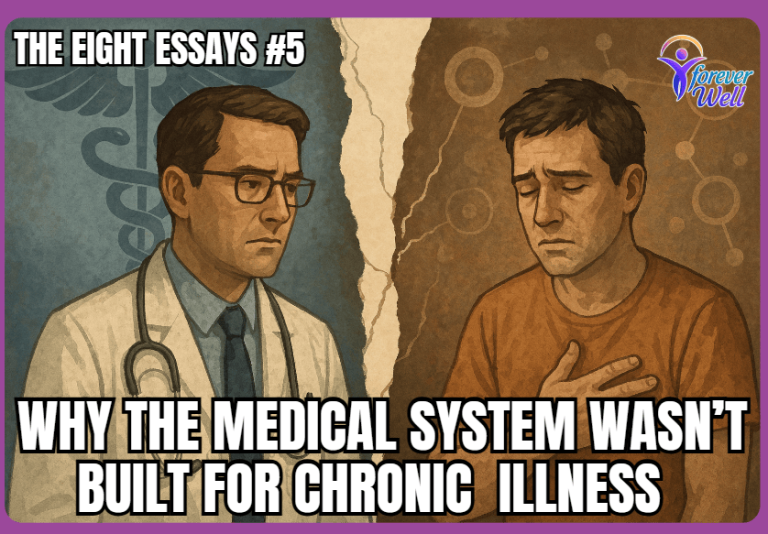
We’ve explored how chronic illness develops over time, why symptom suppression often fails to restore health, how systems biology more accurately reflects how the human organism behaves, and why a pharmaceutical-centric healthcare system, despite extraordinary strengths in trauma and infectious disease, struggles when faced with long-term, adaptive conditions.
Now it’s time to ask the forward-looking question this entire series has been building toward:
What would a healthcare system designed for restoration actually look like?
Not a rejection of modern medicine.
Not a utopian fantasy.
But an evolution, one aligned with biology, complexity, and lived human experience.
From Heroic Intervention to Restorative Support
Modern medicine is built on what can fairly be called heroic intervention.

When the body is injured, infected, or failing rapidly, decisive action is required. In trauma bays, operating rooms, and intensive care units, this mindset is lifesaving.
Few human achievements rival modern medicine’s ability to intervene dramatically and save lives in crisis.
This strength earned medicine its authority, and rightly so.
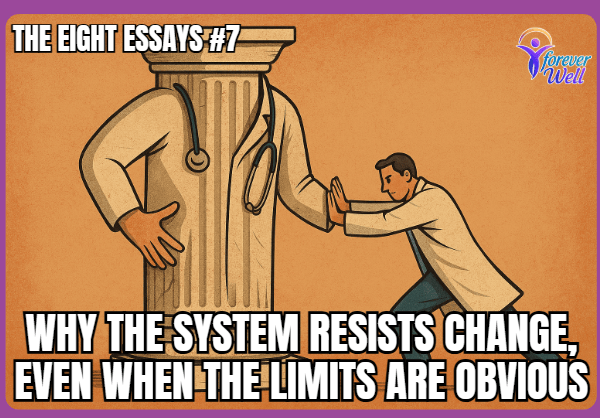
But chronic illness is rarely a sudden failure that demands dramatic rescue.
More often, it is the result of years of adaptation: the body balancing and counterbalancing under sustained stress, nutritional depletion, inflammatory load, metabolic strain, emotional pressure, and environmental burden.
In these cases, the body has not “failed” so much as adjusted to conditions that were never fully resolved.
The disconnect arises when the energy of heroic intervention, force, speed, suppression, is carried into a domain that requires something different: patient support for regulation and recovery.
In chronic illness, restoration is less about overriding the body and more about creating the conditions that allow its inherent intelligence to reassert itself.
From Intervention to Environment
A restoration-oriented system would therefore begin with a shift in focus.
Instead of asking:
Which intervention controls this symptom?
It would ask:
What conditions allowed this imbalance to develop, and what conditions would allow the body to recover?
This is the central insight of systems biology: living organisms are not machines with broken parts. They are adaptive systems, constantly balancing and counterbalancing in response to their environment.
Health is not imposed.
It emerges.
When conditions improve, biology responds.
Medicine’s role, then, is not always to force biological outcomes, but to support the body’s own capacity to restore balance.
A Broader Definition of “Treatment”
In such a system, treatment would no longer be synonymous with medication or procedure.
It would include:
- nutrition that stabilizes metabolism and reduces inflammatory load
- sleep restoration that recalibrates hormonal and nervous-system rhythms
- movement that restores signaling, circulation, and resilience
- stress regulation that quiets chronic threat responses
- environmental awareness that reduces cumulative biological burden
- relationships, meaning, and purpose, now recognized as physiological influences, not psychological afterthoughts
Pharmaceuticals would still be available as tools within this system, but they would no longer occupy the center of care for chronic conditions. They would be used strategically and sparingly, supporting stability when needed, but never mistaken for restoration.
That distinction matters.

Expanded Toolkits for Clinicians
A healthcare system designed for restoration would equip clinicians with more than two primary tools: drugs and surgery.
It would train them to:
- recognize early imbalance before disease labels appear
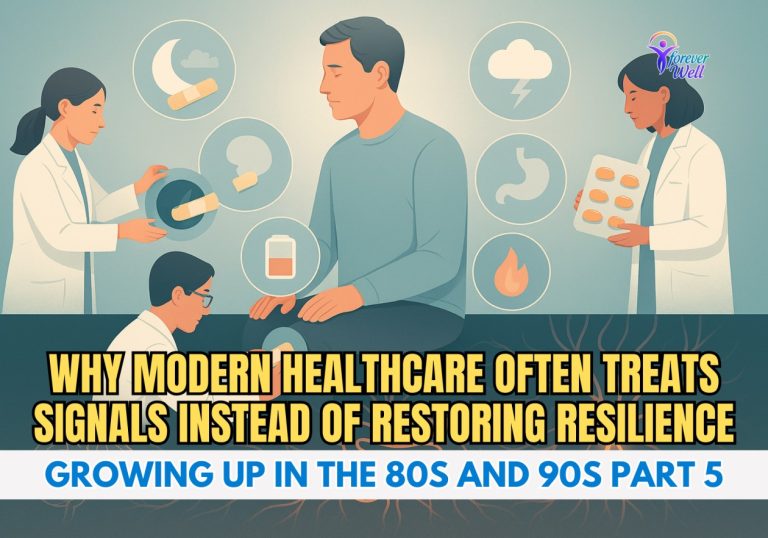
- interpret symptoms as signals rather than inconveniences
- work upstream of pathology
- support recalibration rather than merely suppress outcomes
- collaborate across disciplines instead of practicing in isolation
When the toolkit is broader, intelligence has room to operate.
And something else happens as well: the work becomes meaningful again.
Instead of applying the same interventions repeatedly with predictable but limited results, clinicians are invited to think, observe, and adapt.
They see patterns emerge. They watch physiology respond. They participate in genuine recovery rather than endless management.
For many doctors practicing in systems-based and functional models, this restores something that drew them to medicine in the first place: the satisfaction of using intelligence to solve complex human problems, and seeing people actually get better.
Burnout as a Signal of Misalignment
It is no coincidence that physician burnout has risen alongside the explosion of chronic illness.
Burnout is often framed as a problem of workload, documentation, or efficiency. Those factors matter. But beneath them lies a deeper source of distress: the repeated experience of treating without restoring.

Managing decline indefinitely erodes meaning.
Highly trained, intelligent clinicians do not burn out simply because they are busy. They burn out when they are constrained to practice beneath their understanding, when they sense that more is possible but lack the tools, time, or permission to pursue it.
A restoration-oriented system not only improves patient outcomes.
It restores professional fulfillment.
Time as a Therapeutic Asset
Perhaps the most radical shift in such a system would be how time is valued.
When the right conditions are restored, the body often responds far more quickly than expected, while deeper resilience rebuilds more gradually as regulatory systems regain stability.
Care would emphasize:
- continuity rather than episodic visits
- longitudinal tracking rather than snapshots
- adjustment rather than rigid protocol adherence
Time would no longer be the enemy of care.
It would be part of the medicine.
Redefining Success
In the current system, success is often defined as:
- numbers in range
- symptoms controlled
- disease “managed”
- risk reduced
A restoration-oriented system would ask different questions:
- Is energy returning?
- Is resilience improving?
- Is adaptability increasing?
- Is life expanding rather than narrowing?
These outcomes are harder to quantify, but far closer to how people actually experience health.
The Patient as Participant, Not Problem

In a system designed for restoration, patients would no longer be passive recipients of care.
They would be:
- observers of their own patterns
- partners in experimentation
- contributors of essential data
- active participants in recovery
This does not mean blame.
It means relevance.
No clinician lives inside another person’s body. The lived experience of energy, sleep, mood, digestion, and vitality is not anecdotal noise, it is primary information.
In this sense, the most important doctor a person will ever consult is the one they see in the mirror each morning, not because medical expertise no longer matters, but because awareness does.
Environment as Medicine
At its core, restoration-based care rests on a simple truth:
Living systems tend toward balance when conditions allow.
This is not a guarantee.
It is a tendency.
History matters. Severity matters. Constraints matter.
But directionality matters too.
When stressors are reduced and resources restored, the human organism often does what it has always done, adapt, repair, and re-regulate.
A Maturing View of Medicine
This vision does not ask us to abandon modern medicine’s greatest achievements.
It asks us to contextualize them.
Acute care remains extraordinary.
Infectious disease treatment remains essential.
Trauma care remains lifesaving.
But chronic illness demands something different.
It demands humility, patience, collaboration, and a deeper respect for how living systems behave.

That is not a retreat from science.
It is its maturation.
Where This Leaves Us
The healthcare system we inherited was designed for the problems of its time.
The problems have changed.
A system designed for restoration would:
- honor biology
- expand the clinical toolkit
- value time and relationship
- invite participation without blame
- restore meaning to clinical work
- and define success as regained vitality, not merely managed disease
This is not an attack on medicine.
It is a call for its evolution.
Because when the goal is not merely survival, but health, the system must finally align with how the human body actually works.
And when it does, something important becomes clear:
What we do matters.
The environment matters.
Participation matters.
And health, once thought lost, often proves far more responsive than we were ever led to believe.
That is not false hope.
It is biology, finally taken seriously.