
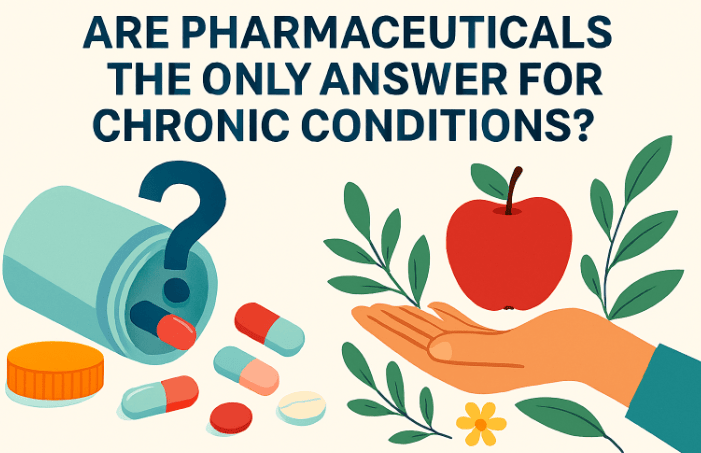
Are Pharmaceuticals the Only Answer for Chronic Conditions?
As chronic and autoimmune diseases surge worldwide, healthcare professionals and patients are questioning whether conventional medicine alone can truly offer solutions.
A growing number are seeking alternatives—approaches that go beyond symptom suppression to address the underlying causes of illness.
This is where functional and natural medicine come into focus. By emphasizing root-cause resolution, physiological synergy, and the body’s innate capacity to heal, functional medicine offers a compelling alternative to the pharmaceutical-centered model.
Ask a critical question: Could functional medicine become the new standard of care, with pharmaceuticals serving a supportive role rather than the default solution?

Natural and functional medicine for autoimmune and chronic diseases, focuses on supporting the body’s systems rather than suppressing symptoms.
This approach offers an increasingly credible and compassionate alternative.
In this article, I explore why a shift is needed, what biases sustain the pharmaceutical status quo, and how functional medicine may redefine the future of chronic disease care.
Here at ForeverWell, I am deeply committed to shining a light on the limitations of the pharmaceutical approach to treating chronic and autoimmune diseases.
Quite simply they do not work as evidenced by the fact that you are expected to use the treatments for the rest of your life. They are not curative
The Pharmaceutical Approach: A Model of Interference
Pharmaceutical drugs are designed primarily to interfere with specific biological mechanisms.
They work by blocking receptors, inhibiting enzymes, altering neurotransmitters, or suppressing immune responses.
While these interventions can be life-saving in acute situations, they frequently fall short when applied to chronic and autoimmune conditions.
Take methotrexate, for example, a drug commonly prescribed for autoimmune diseases such as rheumatoid arthritis.

Although it is often labeled an “immune suppressant,” methotrexate actually suppresses all rapidly dividing cells by inhibiting folate metabolism.
This effect extends beyond immune cells to healthy tissues in the gut, bone marrow, and reproductive system. As a result, patients may experience liver toxicity, fatigue, nausea, and, in some cases, long-term organ damage.
The belief that drug side effects occur only after long-term use is a dangerous oversimplification.
Many pharmaceuticals carry short-term risks that can emerge within hours or days, including allergic reactions, mood changes, gastrointestinal distress, and acute liver injury.
This misleading narrative—that only prolonged use carries risk—arises from a blend of optimism bias, framing bias, and a medical culture that often emphasizes benefits while minimizing harm.
Pharmaceutical companies, time-constrained clinicians, and insurance payers all benefit from the perception that drugs provide fast, safe solutions, even when deeper healing remains unaddressed.
The Functional Medicine Model: A Philosophy of Synergy
In contrast, functional medicine focuses on uncovering and addressing the root causes of illness by viewing the body as an interconnected system.
Rather than overriding biological pathways, it actively supports them through a personalized, systems-based approach. This includes evaluating:
- Nutritional status
- Environmental toxin exposure
- Gut health and the microbiome
- Stress and psychological well-being
- Genetic predispositions
- Lifestyle factors like sleep, movement, and circadian rhythm

Instead of simply managing symptoms, functional medicine emphasizes restoring the body’s natural function—empowering it to heal through harmony and synergy, not suppression.
Therapies may include anti-inflammatory diets, botanicals, detoxification protocols, microbiome restoration, stress management techniques, and targeted supplementation, all tailored to nurture the body’s innate ability to thrive.
Why Pharmaceuticals Still Dominate Chronic Care
Even as evidence supporting functional medicine grows, pharmaceuticals continue to dominate chronic care. Why is that?
- Medical Training Bias: Conventional medical education emphasizes pathophysiology and pharmacology. Doctors are trained to diagnose and prescribe—not to assess nutrient levels, evaluate toxin exposures, or craft personalized lifestyle plans.
- Economic Incentives: Pharmaceutical companies fund medical schools, journals, and continuing education. Their products are patentable and highly profitable, unlike most natural therapies. Insurance typically covers drug treatments, not the more holistic, time-intensive care that functional medicine offers.
- Time Constraints: The average primary care visit lasts only 15 minutes, leaving little room to explore diet, sleep, stress, or environmental exposures in depth.
- Regulatory Pressure: Physicians must follow standard-of-care guidelines, which prioritize pharmaceutical interventions. Deviating from these standards can carry liability risks.
- Public Expectation: Patients often expect a quick fix—a pill for every symptom—rather than a comprehensive, multi-month functional medicine plan.
- Scientific Reductionism: Western medicine excels at linear, single-cause models, but chronic illness is complex and multifactorial. Addressing it effectively requires the systems-based approach that functional medicine embraces, even when it doesn’t fit neatly into conventional trial designs.

Case Study: Cleveland Clinic’s Center for Functional Medicine
A striking real-world example of functional medicine in action is the Cleveland Clinic Center for Functional Medicine, founded in 2014 by Dr. Mark Hyman and now led by Dr. James E. Carter.
The center demonstrates how functional medicine can thrive within a major academic institution, offering a model for systemic change.
Their approach brings together a multidisciplinary team of physicians, dietitians, health coaches, and behavioral therapists.
Programs like Functioning for Life™ provide 10-week group medical appointments that help patients uncover and address the root causes of diabetes, autoimmune disorders, and digestive conditions.
A 2019 study in JAMA Network Open found that patients at the center experienced significantly greater improvements in health-related quality of life compared with those receiving conventional primary care, highlighting the transformative potential of this systems-based approach.
Is It Time for a Paradigm Shift?
The growing body of evidence makes it clear that we need to rethink our default strategies.
Functional medicine and natural medicine provides a foundational framework for care—restoring biological resilience instead of merely suppressing symptoms.
Pharmaceuticals can play a role as supportive tools, rather than serving as primary interventions.

This doesn’t mean abandoning medications entirely. In acute situations or advanced disease, drugs may be essential and lifesaving.
But for the long, nuanced journey of reversing chronic illness, a model rooted in addressing underlying causes and nurturing physiological synergy is not only more logical—it is increasingly supported by science.
Conclusion: Integration, Not Opposition
Should natural and functional medicine replace pharmaceutical medicine as the standard for care?
Absolutely. It should serve as the primary approach, with pharmaceuticals taking a secondary, supportive role for managing acute symptoms, like the pain of a migraine.
By embracing this shift, we can move toward a healthcare model that is more effective, sustainable, and in harmony with the body’s innate capacity to heal.
Functional medicine is not just a trend—it represents an essential evolution in how we understand, address, and ultimately reverse complex, chronic illness.