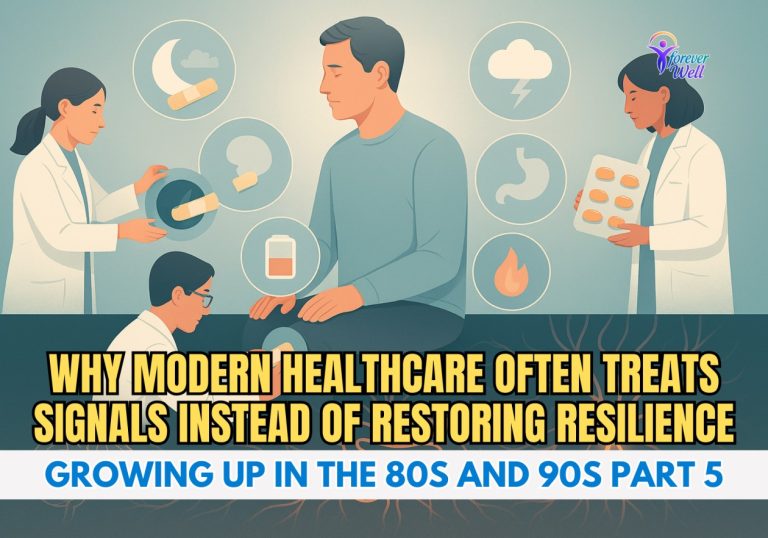

By the time the children of the 1980s and early 1990s reached adulthood, a quiet contradiction had begun to emerge.
They weren’t obviously sick.
They were functioning.
They were building careers, raising families, and meeting responsibilities.
And yet, many carried a persistent, difficult-to-explain realization:
I’m doing everything right—but it feels harder than it should.
This experience rarely had a clear diagnosis. It often failed to appear on lab tests. It was frequently attributed to stress, personality, or simply the unavoidable weight of adult life.
But for many in this cohort, this wasn’t random.
It was the adult expression of systems that had learned how to respond early in life, but had fewer opportunities to learn how to recover.
When Normal Test Results Don’t Feel Like Health
Adults from this generation often describe a recognizable cluster of experiences:
- Persistent fatigue that rest does not fully relieve
- Anxiety without a clear external cause
- Low-grade depression that feels more like emotional flatness than sadness
- Digestive instability that comes and goes
- Heightened sensitivity to sleep loss, travel, or stress
- Slower recovery after illness or exertion

They seek medical care. Blood tests are ordered. Imaging may be performed.
Results frequently return normal.
They are told, often truthfully:
- “There is nothing dangerous happening.”
- “Your labs look good.”
- “Many people feel this way.”
What remains unexplained is the gap between disease detection and resilience measurement.
Modern medicine is highly skilled at identifying structural disease.
Many adults in this cohort are living with diminished adaptive capacity—something medicine has historically struggled to measure.
Development Didn’t End in Childhood
One of the most important insights for understanding this generation is often overlooked:
The systems that shape resilience continue developing well into adolescence and early adulthood.
Just as the immune system matures through exposure and calibration, the nervous system develops through repeated cycles of activation and recovery.

It learns:
- When to mobilize
- How intensely to respond
- When to stand down
- How to return to baseline
These lessons are not taught in classrooms.
They are taught through lived physiological experience.
For many in this cohort, those experiences increasingly favored activation over recovery.
ADHD as an Early Signal of Regulation Load
For many children of the 80s and 90s, ADHD became the first visible sign that regulation was difficult.

At the time, ADHD was understood primarily as:
- A behavioral condition
- A neurochemical imbalance
- A challenge involving attention and impulse control
Medication often improved classroom function and academic performance, and for many families it was genuinely helpful.
But with hindsight, ADHD frequently reflected something broader:
- Difficulty shifting between states
- Poor recovery after stimulation
- Heightened nervous system reactivity
- Trouble settling once activated
The behavior improved.
The regulatory challenge often remained beneath the surface.
Anxiety: When Activation Becomes the Baseline
As this cohort moved into adolescence and early adulthood, anxiety often replaced hyperactivity as the dominant experience.
Not dramatic panic at first, just:
- Persistent worry
- Overthinking
- Perfectionism
- Hyper-responsibility
- Difficulty relaxing
- A sense of internal tension without clear cause
These traits were often rewarded socially. They appeared to reflect ambition, diligence, and maturity.
Biologically, however, they frequently represented a nervous system spending increasing time in a state of activation.
Stress physiology is designed to function as a temporary shift in priority. When the brain perceives threat, physical, social, or emotional, the body reallocates energy toward vigilance, readiness, and rapid response.

Human stress systems evolved to handle immediate, life-threatening danger.
When our ancestors encountered a predator, their bodies launched a powerful survival response. Blood flow shifted toward the large muscles needed to run or fight. Digestion, repair, and long-term maintenance were temporarily paused.
The critical feature of this response was not its intensity, but its completion. Once the danger passed, the stress response shut down and the body returned to recovery mode.
Modern stress rarely works this way.
Deadlines, financial pressure, relationship strain, and constant stimulation often keep the stress response partially activated, but without clear resolution. The body remains prepared for danger that never fully arrives, or never fully ends.
Anxiety, in this context, is not a personality flaw.
It is the felt experience of a system waiting for completion.
Depression as Physiological Conservation
For many adults in this cohort, depression did not emerge primarily as deep sadness.
Instead, it appeared as:
- Emotional numbness
- Loss of motivation
- Reduced joy
- Cognitive fatigue
- A sense of moving through life at a distance

Often after years of sustained anxiety.
This progression is not accidental.
When the body remains in prolonged readiness, continually adapting, compensating, and mobilizing, energy reserves gradually narrow. What appears psychologically as depression often represents physiological conservation.
The system reduces emotional intensity and drive not because it is failing, but because it cannot sustain constant activation without recovery.
Why Insight Helps—but Rarely Completes the Process
Many adults in this cohort understand their anxiety or depression intellectually.
They know:
- Their triggers
- Their patterns
- Their history
They pursue therapy. They develop insight. They learn coping strategies.
And yet, the feeling often persists.
This is not because insight lacks value.
It is because awareness alone does not change physiological state.
A person can understand that they are safe while their body continues to behave as if vigilance is still required. Without consistent experiences of completion, deep rest, sensory quiet, uninterrupted sleep, periods without demand, the stress response does not fully stand down.
Symptoms soften.
But recovery remains incomplete.
A Developmental Reframe
Here is the central reframe of Part 2:
Anxiety and depression in this cohort often reflect prolonged activation without sufficient opportunities for recovery.
This does not invalidate therapy, medication, or psychological insight.
It explains why those tools frequently help, yet sometimes feel incomplete.
They address meaning, perception, and coping.
They do not always restore the physiological rhythm between activation and restoration.
The Question Adults Eventually Begin Asking
By midlife, many people stop asking:
“What diagnosis do I have?”
And begin asking:
“Why does everything feel like effort?”

That question is not simply psychological.
It is developmental.
It reflects systems that learned to mobilize effectively, but were given fewer opportunities to learn how to stand down.
Why This Matters Before Moving Forward
Understanding fragility through a developmental lens helps explain why:
- Symptom-based care often provides partial relief
- Mental health treatment sometimes feels incomplete
- Lifestyle advice can feel overwhelming rather than restorative
- Many people sense there must be a deeper explanation for how they feel
There is.
But to understand it fully, we must examine not only internal development, but the external environment that continuously shapes it.
Coming Next in Part 3
In Part 3, we explore a force that quietly intensified activation across this entire cohort:
Technology.
Constant connectivity, persistent stimulation, and the loss of natural recovery cues did not create fragility, but they often prevented it from resolving.
And without understanding how modern environments disrupt biological completion, the path to resilience remains incomplete.