“Science ceases to be science when those who make the claims control who can verify them.”
There was a time when medical science aspired to the same standard of truth as physics or chemistry, where data were shared, methods were disclosed, and results could be independently confirmed.
Today I want to show you how drug company money is undermining science.
In our world of pharmaceutical dominance, the foundations that once gave science its credibility — transparency, replicability, and independence — have been replaced with secrecy, selective disclosure, and profit driven storytelling.
I am not accusing anyone of outright fraud. I am describing a system that quietly rewards control over knowledge instead of the honest pursuit of truth.

This topic is discussed frequently in the books and reports I have read. My focus is to help readers understand the depth of corruption within our healthcare landscape.
That corruption is the result of the interests and control of healthcare by Big Pharma, the 500 pound gorilla in the room.
When I write about these issues, my intention is to inform and to encourage thoughtful awareness. I believe in science with all my heart and I have learned to recognize what represents strong evidence and what falls short.
My hope is for a healthcare system that evolves with integrity and cares for people before profits.
The Principle of Good Science and How Medicine Abandoned It
Science rests on a simple rule. If you make a claim, others must be able to test it for themselves.
This principle of open data, open methods, independent replication is the foundation of every real scientific breakthrough.
It is the reason Einstein shared his equations, why physicists reveal detector data, and why chemists describe each step of their experiments.

Yet in modern medicine, especially in pharmaceutical research, this principle has been systematically weakened.
Drug company money is undermining science by limiting access to full data and restricting who can verify results.
What should be open and transparent becomes controlled and hidden, leaving independent scientists outside the doors they once freely entered.
Data as Property, Not Evidence
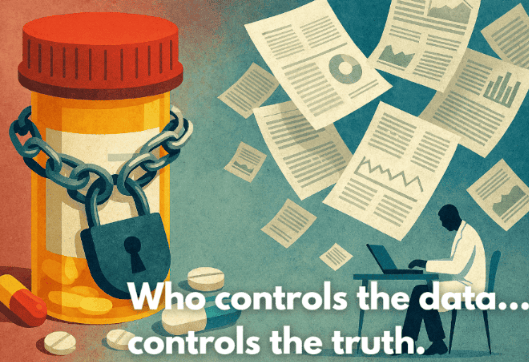
Today most clinical trial data belong to the drug company that funds the research.
Academic investigators and journal editors rarely see the raw evidence. Even when a study appears in trusted journals like The New England Journal of Medicine or The Lancet, the public only receives the company’s filtered version.
We see polished tables, selected graphs, and interpretations crafted by corporate statisticians rather than the full truth beneath them.
Peer reviewers cannot verify the data. They have no access.
Even the academic authors listed on the paper often sign non-disclosure agreements that prevent them from seeing or sharing the complete datasets. Drug company money is undermining science by turning evidence into private property.
So when you or your physician read a published trial and believe that independent experts have confirmed its findings, the reality is unsettling.
In many cases, no one outside the company has checked whether the data even support the conclusions.
The Replication Crisis You Never Hear About
In the natural sciences, when results cannot be replicated, everyone calls it a crisis. In medicine, people too often call it business as usual.
Drug company money is undermining science by limiting which findings the world can verify.
Fewer than fifteen percent of published clinical trials make their full patient level data available to outsiders.
The FDA and HHS hold these datasets yet classify them as confidential commercial information. Even Freedom of Information Act requests for raw data are routinely denied.
As a result, the scientific claims that drive billions of dollars in drug sales remain out of reach for independent scrutiny.
On the rare occasions when researchers do gain access, their discoveries can be shocking:
- The antiviral Tamiflu was sold to governments worldwide as a life saving flu treatment — until independent reviewers finally obtained the raw data and discovered the drug did not reduce hospitalizations or serious complications.
- Paxil Study 329 was published by GlaxoSmithKline in 2001, claiming antidepressant benefits for adolescents. A later reanalysis revealed no improvement and a troubling rise in suicidality.
- Merck’s Vioxx trials concealed cardiovascular risks that internal data already showed were deadly.
These situations were not simple mistakes.
They were the predictable result of a system in which the same companies that profit from the outcomes also control the evidence, the narrative, and who gets to see the truth.
The Art of Data Manipulation
This is rarely outright falsification. Instead, it is subtle, sophisticated, and much harder to detect. Drug company money is undermining science by shaping how trial results are presented, often without anyone outside the company realizing it.
Here are a few ways drug trial data are quietly massaged:
- Outcome Switching: When the original endpoint, like mortality, fails, analysts highlight a secondary outcome, such as symptom reduction, and present it as the main finding.
- Comparator Bias: New drugs are tested against placebos or under dosed older drugs instead of the best available therapy, virtually ensuring they appear superior.
- Statistical Spin: Non-significant results are reframed as “trends toward improvement” or “clinically meaningful benefits.”
- Data Imputation: Dropouts from side effects are statistically carried forward as if they remained stable, hiding harm.
- Selective Publication: Trials with negative outcomes simply disappear; only favorable studies reach journals.
Each technique alone might seem minor, but together they form a powerful machinery of distortion, turning ambiguous science into clear marketing.
And because the journals themselves have been captured, this careful choreography almost always goes unchallenged.
The Capture of the Medical Journal System
If science is the soul of medicine, medical journals are meant to be its conscience, the independent gatekeepers of truth.
But those gates have been purchased.
To me, this is one of the saddest ways drug company money is undermining science.
Our healthcare system no longer has an impartial arbiter.
How It Happened
When a blockbuster drug’s clinical trial appears in JAMA, NEJM, or The Lancet, the sponsoring company often buys hundreds of thousands of reprints to distribute to physicians.
These glossy reprints can bring a single journal millions in profit. Advertising revenue adds even more.
Journals that publish more industry-funded trials earn higher impact factors because those papers are heavily cited.
High impact attracts more advertising and submissions, creating a self-reinforcing loop:

As one editor bluntly admitted:
“Medical journals have become an extension of the marketing arm of pharmaceutical companies.” — Richard Smith, former editor, BMJ
The Peer-Review Mirage
Peer review sounds rigorous, but reviewers rarely see the full data. They rely on what the company provides.
Even academic authors often cannot confirm analyses — their names lend prestige, yet their access remains limited.
Marcia Angell, MD, who resigned as editor of The New England Journal of Medicine over these issues, wrote:
“It is simply no longer possible to believe much of the clinical research that is published… or to rely on the judgment of trusted physicians or authoritative medical guidelines.”
Following her departure, Angell published the powerful book The Truth About the Drug Companies.

Though released in 2005, the concerns she raised have only intensified.
I highly recommend it to anyone who wants to understand this subject.
When the very stewards of science sound this alarm, it is not cynicism — it is careful diagnosis.
The Illusion of Oversight
You might hope that federal agencies — the FDA, NIH, or HHS — act as backstops, catching distortions and protecting the public.
In theory, yes. In practice, oversight is fragmented and often depends on the very companies being overseen.
Drug company money is undermining science not just in labs but in the halls of regulation.
Historically, the FDA has inspected only about one percent of clinical trial sites. Even when violations surface, the results rarely reach the public.
And with roughly two-thirds of the FDA’s drug-review budget now funded by industry “user fees,” the agency has become financially tethered to the companies it regulates.
The revolving door between corporate boardrooms and federal agencies keeps turning, quietly eroding public trust.
Yet there is a glimmer of hope. As I noted in my piece on our new FDA Director, Marty Makary, MD, he has made a bold effort to shine light on these issues and challenge our healthcare system to be more transparent and honest.
His appointment is a cause for celebration, and we should all be rooting for his success.
The Consequences
The cost of this captured system is not only intellectual — it is deeply human:
- Drugs with overstated efficacy claims flood the market, while safer, non-patentable alternatives are sidelined.
- Clinical guidelines, built on biased evidence, shape prescribing practices for decades.
- Physicians, overwhelmed by glossy “peer-reviewed” papers, unknowingly rely on partial truths.
- Patients, trusting the system, become unwitting participants in a grand commercial experiment.
When the public loses faith in science, the damage goes far beyond any single drug. It erodes the sacred bond between medicine and society, the belief that truth, not profit, guides our pursuit of healing.
Reclaiming Science as a Public Good
Rebuilding integrity will require bold, radical transparency:
- Full public access to raw clinical trial data, not just company-curated summaries.
- Independent replication of pivotal studies before regulatory approval.
- Firewalls between journals and corporate money.
- Reformed peer review, making data verification a requirement rather than an afterthought.
- Public funding for comparative effectiveness research to reduce corporate monopoly over knowledge.
The goal is not to vilify every company or scientist in the system. It’s to recognize that drug company money is undermining science and that a science dominated by proprietary data, bought journals, and manufactured consent is not science at all.
“Medicine has become a marketplace of data without verification, journals without independence, and regulators without distance.”
Closing Thoughts
The public still believes in science — and it should. But that faith must be earned through transparency, not demanded through authority.
If medicine is to regain its soul, it must return to the ethic that once defined scientific inquiry: no claim beyond verification, no secrecy in discovery, and no truth for sale.