
Across the first five parts of this series, we traced a developmental story.
- Early medical intervention shaped immune learning
- Chronic stress shaped nervous system regulation
- Technology disrupted recovery rhythms
- Food environments reshaped metabolic and digestive signaling
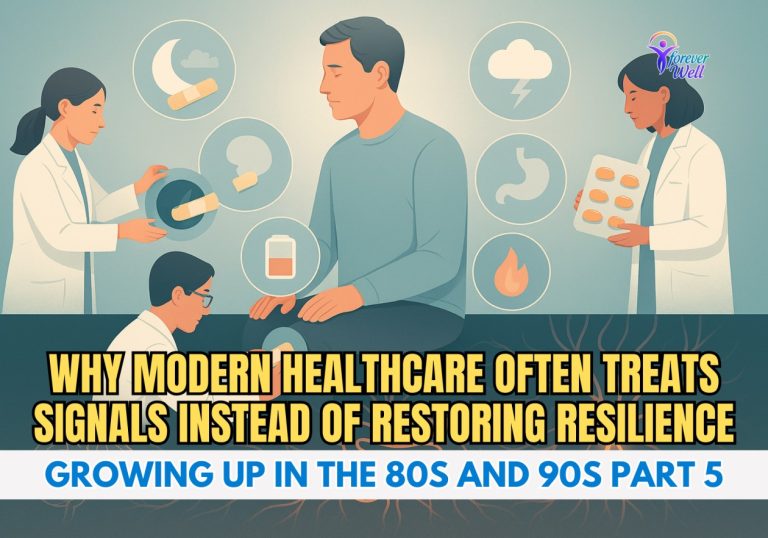
- Modern healthcare often learned to manage symptoms without restoring resilience
This final piece begins where the others were leading.
Not toward blame.
Not toward rejecting modern medicine.
But toward biological possibility.
Because the most important truth underlying this series is this:
The same adaptive intelligence that shaped fragility can help rebuild vitality.
Restoration Is Not the Opposite of Treatment
Restoration does not mean ignoring symptoms.
It does not mean abandoning medications when they are necessary.
It does not mean returning to a romanticized past.

Restoration means shifting the primary clinical question from:
“How do we control what is happening?”
to:
“What conditions allow the body to regulate, repair, and recover?”
The Body as a Self-Regulating System
The human body operates through balancing and counterbalancing mechanisms across immune, digestive, metabolic, nervous, and endocrine systems.
Health depends on:
- Proportion rather than intensity
- Rhythm rather than force
- Coordination rather than domination
When these systems are supported, regulation emerges naturally.
When they are chronically interrupted, symptoms appear.
Restoration Begins With Rhythm
Before protocols, supplements, or treatment plans, restoration begins with restoring biological rhythm.

The body depends on predictable cycles:
- Sleep and wake timing
- Feeding and metabolic rest
- Activity and recovery
- Engagement and quiet
Many adults lost these rhythms long before they lost health.
Reintroducing rhythm sends one of the most powerful biological messages:
It is safe to recover.
Stress Completion: Allowing the Cycle to Finish
Modern life produces ongoing stress without closure.
Restoration requires experiences that allow stress physiology to complete:
- Movement
- Breathing practices
- Time in nature
- Emotional expression
- Sensory quiet
- Genuine rest
When stress cycles complete, digestion improves, immune balance stabilizes, and energy reliability increases.
Digestive Restoration: The Central Hub
Digestive function influences:
- Nutrient absorption
- Microbiome signaling
- Immune tolerance
- Neurotransmitter production
- Metabolic stability
- Inflammatory balance

Restoration supports digestion through nourishment, rhythm, diversity, and reduction of chronic digestive burden.
Metabolic Flexibility Instead of Control
True metabolic resilience allows the body to:
- Stabilize blood sugar
- Access stored energy
- Signal hunger and fullness reliably
- Recover after exertion
Restoration emphasizes nourishment, micronutrient density, and metabolic rhythm rather than restriction or punishment.
The Nervous System Learns Through Experience
Insight alone does not restore regulation.
The nervous system learns safety through repeated physiological experiences such as:
- Predictable daily structure
- Calm environmental cues
- Meaningful human connection
- Gentle movement
- Reduced stimulation
Over time, baseline activation shifts.
Immune Tolerance and Inflammation Balance
Immune systems are designed to be proportional, not silent.

Restoration supports immune balance through:
- Digestive integrity
- Microbial diversity
- Stress regulation
- Sleep restoration
- Nutrient sufficiency
Inflammation quiets when balance returns.
Epigenetics and the Biology of Repair
Gene expression remains responsive throughout life.
Changes in sleep, nutrition, digestion, stress physiology, and environment gradually influence regulatory signaling.
Genes do not need to be overridden.
They respond to improved biological conditions.
Why Restoration Feels Gradual
The body repairs the same way it developed: incrementally, contextually, and in sequence.
Energy often improves first.
Sleep deepens next.
Mood and inflammation follow.
These changes reflect systems re-establishing communication.
Restoration is gradual — but it is rarely invisible.
Why Improvement Often Begins Sooner Than Expected
Although full restoration of resilience develops gradually, many patients working with restoration-based practitioners experience noticeable improvement earlier than they expect.

This occurs because certain regulatory systems respond quickly once chronic biological stressors are reduced and supportive signals are reintroduced.
Patients frequently report early changes such as:
- More stable daily energy
- Improved sleep quality
- Reduced digestive discomfort
- Greater emotional steadiness
- Decreased inflammatory flares
- Improved tolerance to physical or psychological stress
These early improvements do not represent complete restoration. Instead, they reflect the body’s initial shift away from chronic compensation toward regulatory balance.
In many ways, these early changes serve as biological confirmation that the restoration process has begun.
Deeper resilience, such as long-term metabolic flexibility, immune recalibration, mitochondrial efficiency, and sustained stress tolerance, often develops over a longer period of consistent support.
Understanding this distinction helps patients remain encouraged while maintaining realistic expectations about the restoration timeline.
The Role of Medicine in the Restoration Model
Modern medicine remains essential for diagnosis, safety, and acute care.
Restoration does not replace medicine.
It completes it.
When disease control and resilience restoration operate together, outcomes often improve, and dependency on symptom management may gradually decrease.
A Personal Note About This Series
Before closing this series, I want to be clear about something important.
I am not a physician, and this series is not intended to diagnose, treat, or prescribe medical care. What I am presenting is a conceptual framework shaped by more than three decades of observing the evolution of healthcare, particularly within the natural and functional medicine communities.
Over those years, I have watched clinicians struggle with patients who feel unwell despite normal testing and layered symptom management.

I have also witnessed the emergence of a different clinical model, one focused on rebuilding resilience by supporting digestive function, metabolic stability, stress completion, immune tolerance, and regulatory balance.
This restoration pathway is not theoretical. It is the working framework used by many practitioners trained in functional, integrative, and systems-based medicine.
Why Partnership Matters
Restoration is rarely a solo journey.
It often requires a healthcare partner who understands how multiple biological systems interact and who works collaboratively over time rather than chasing isolated symptoms.
Finding a practitioner who shares this philosophy can transform the healing experience.
A Final Encouragement
If this series resonates with your experience, I encourage you to explore working with healthcare professionals trained in restoration-based approaches such as functional, integrative, or natural medicine.
Not because they hold all the answers.
But because these disciplines often organize care around the same resilience-building principles described throughout this series.
Healing is rarely linear.
Recovery is rarely instant.
But resilience can return.
And it returns most reliably when patients and practitioners walk that path together.
Final Thought
If you were born in the 1980s or 1990s and feel fragile, anxious, inflamed, or exhausted, the answer is not that your body failed.
It adapted.
And adaptation can change when the right conditions are restored.