If you’ve ever watched television for more than half an hour, you’ve probably noticed it: a parade of advertisements of pharmaceutical medicine ads, each featuring cheerful people dancing, picnicking, or simply enjoying life.
And yet, beneath that glossy imagery is a rapid-fire list of adverse drug reactions and side effects.
When I hear that list, I often think,
“Who would willingly take something that could cause all this?”
The truth is, these side effects aren’t just random—they’re directly tied to how drugs work in our bodies. And it’s worth taking a closer look.
Relief Comes at a Cost

Every drug works through interference. Relief comes at the cost of disruption. That disruption which is blocking, suppressing, inhibiting, or otherwise interfering with normal body mechanisms and pathways is exactly what gives rise to side effects.
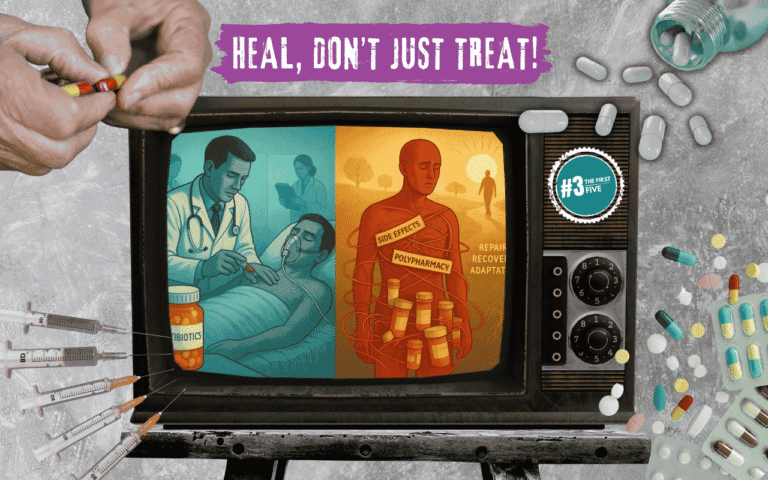
I explained this briefly in First Five #3, but it’s worth repeating: medication doesn’t add to the body, it alters it.
How any individual responds depends largely on their genetic makeup and unique physiology. Our bodies are remarkable systems of balance and counterbalance, always working to maintain harmony.
When a drug interferes, the body must adjust. One person may adapt with little consequence, while another may react very differently.
How Medicine Classifies Reactions
Science and medicine are well aware of the issues surrounding adverse drug reactions and side effects. In fact, they classify them into five main categories:

- A. Augmented: Predictable and dose dependent
- B. Bizarre: Unpredictable, often immune-related
- C. Chronic: Long-term effects
- D. Delayed: Reactions appearing after extended use
- E. End of Use: Withdrawal side effects
Of these, End of Use is particularly sobering. Some drugs can cause such deep realignments in the body’s balancing mechanisms that stopping them becomes extremely difficult.
What It Means for Long-Term Use
While these classifications help us understand patterns, the bigger message is this: the energy of interference is always detrimental in some way to the human organism.
Drugs can be appropriate and even lifesaving only when used short term for acute problems like infections. But when it comes to everyday, long-term use, we need closer scrutiny.
For chronic and autoimmune conditions, medications are often prescribed with the expectation that you will take them indefinitely, often for life.
That’s why it’s so important to step back, look honestly at the risks and benefits, and consider how these choices affect not just symptoms, but the body’s ability to maintain its natural balance over time.
Proper Use of Pharmaceuticals in the Treatment of Chronic Conditions
If you become a fan of our efforts, you will quickly learn that I mainly advocate for a reduction in our reliance on pharmaceutical medications. They have a clear role in trauma and infectious diseases, but a much more limited application in chronic conditions.
Take migraines, for example. If a drug can stop an attack in its tracks, by all means, use it when needed. But it’s also important to recognize that the same medication won’t prevent the next migraine from happening.
Or consider high blood pressure. Diet and lifestyle shifts, such as improving nutrition, managing stress, and prioritizing movement can often bring blood pressure back into a healthy range.
Still, I fully understand that life can be demanding, and sometimes the quick fix of medication feels like the most practical choice at the moment.
Why Awareness Matters
My goal here isn’t to dismiss pharmaceuticals altogether, but rather to raise awareness about your options.

Every one of us must make choices that serve our bodies, our health goals, and the seasons of life we find ourselves in.
What frustrates me most is that modern medicine and many doctors trained within that system are deeply shaped by a pharmaceutical-first approach.
This bias often means they are not equipped to guide patients toward the natural and functional medicine protocols that may be equally, if not more, supportive in the long run.
That’s why we, as patients, need to remain curious and proactive. Sometimes that means doing our own research, and often it means partnering with a natural or functional medicine practitioner “who can help us explore safer, more holistic treatment options.”
Long-Term Use and the Problems with Polypharmacy
Let me begin with a fact that often shocks people: pharmaceutical medicines are now the fourth leading cause of death in the United States, coming right after heart disease, cancer, and accidents.

Even more sobering is that at least half of these deaths occur not from misuse or medical errors, but from medications being taken exactly as prescribed.
I’ll never forget an emergency room doctor once telling me about the number of patients he sees because of Tylenol toxicity. In one tragic case, a patient even lost their life. These stories are not as rare as we might like to think.
When We’re Younger vs. Later in Life
In our 40s, if a doctor recommends a statin to help control cholesterol, our bodies are generally resilient enough to handle that interference. But fast forward thirty years, now in our 70s—when the statin has been joined by two, five, or perhaps even eight additional medications for various conditions, and the body’s ability to cope is much less robust.
Research suggests that taking as few as three different medications can be a tipping point, where the combined interference of multiple drugs begins to increase the risk of falls, hospitalizations, and overall frailty. It’s a serious issue, but I bet you didn’t hear about it on the nightly news.
The Hidden Risks of Aging with Medications
This is exactly the stage of life when side effects and adverse drug reactions become most problematic. Nothing in our bodies functions quite as efficiently in our 70s as it did in our 40s and that includes the ability of our liver and kidneys to process and eliminate medications.
Drugs don’t suddenly behave differently in an older body. Interference is interference. But the capacity of our organs to handle that interference declines with age. What once felt manageable in middle age can, decades later, contribute to a cascade of complications that compromise health and quality of life.
Training Our Medical Professionals in the Art of Deprescribing
Doctors are extensively trained in prescribing pharmaceutical medications for chronic conditions. What they often aren’t trained in, however, is the equally important art of reducing dosages, or even eliminating medications altogether, as patients age.
I came across a powerful report in the journal Pharmacy, which I share in the appendix of my pamphlet. It described a senior who had been prescribed nine different medications.

Overwhelmed by the potential side effects, she began refusing them. After a thoughtful deprescribing process, she was down to just two truly essential medications—and her quality of life dramatically improved.
The picture says more than words ever could!
Why Deprescribing Matters
Throughout this series, I’ve highlighted the dangers of side effects and adverse reactions to pharmaceuticals.
At ForeverWell, we advocate for non-pharmaceutical approaches to managing chronic and autoimmune conditions because we’ve seen how natural and functional medicine often produces better long-term outcomes.
These approaches work through the energy of synergy, supporting the body’s balance, rather than through interference.
If you’re currently taking multiple medications, it’s important to check in with your doctors regularly. As you get older, ask whether all your prescriptions are still necessary.
A Shared Responsibility
Most physicians have not been formally trained in deprescribing, but the good news is that guidelines now exist to support them in this process.
These resources can help identify medications that may no longer serve you, and in many cases, can reduce your risk of dangerous side effects.

That said, you must be your own advocate. Be insistent. Ask the hard questions.
Research consistently shows that polypharmacy carries serious risks, particularly in older adults. By working together with your healthcare providers and gently but firmly voicing your concerns, you can take meaningful steps toward safer, more balanced care.
The Bottom Line
It’s time we advocate for an evolution in medical training. One that moves beyond the heavy influence of pharmaceutical companies. Safer, more supportive treatments already exist in the natural and functional medicine world, and there is no good reason why our medical professionals should not also be trained in these approaches.
Honoring the wisdom of the body means recognizing that true healing happens when we shift away from protocols rooted in interference and move toward therapies that work through synergy and supporting the body’s natural capacity to restore balance and health.
“Drug therapies aren’t restoring function — they’re rerouting the alarm system.”