Is health just the absence of disease—or something deeper?
This question has stimulated the interest in holistic medicine. All around the world, people are looking for methods that can help not just disease but also promote balance, vibrancy and a return to equilibrium. Rather than treating just symptoms, holistic health care encompasses the whole person – body mind and spirit – working to create balance in life.
In this post we’re going to explain what is holistic health care, the basic principles, most popular modalities and how it differs from conventional medicine. When you’re done, you’ll understand the mechanics of how holistic concepts operate and make such an inarguable contrast to mainstream medicine.

What Is Holistic Health Care?
I hope to give you a very clear understanding of exactly what is holistic health care and how it is different from modern medicine.
Let me start by reminding you that the best way to differentiate these two approaches to healthcare is to look at the energy that drives their treatment modalities.
- Modern medicine uses pharmaceuticals that operate by way of interference with your body’s mechanisms.
- Holistic care works by way of synergy, an energy that supports the body’s healing mechanisms.
This is clearly a distinction with a difference. How that difference manifests in a patient’s experience provides a very interesting contrast. That’s just a tease for now.
First, I’d like to briefly address the “name” issue.
My natural medicine friends typically use the terms natural medicine, functional medicine, and holistic medicine as synonyms for one another. We certainly have never considered ourselves as “alternative”.
Both complementary and alternative are names that were attached to the movement by the pharmaceutical-centric community. There have been efforts, some very sincere, by major medical schools and treatment centers to incorporate some of the modalities of holistic care into the services they offer their patients.
Sadly, even in the most ambitious cases, the effort to incorporate any aspect of holistic care into the training of our medical doctors has failed, or at best, proceeded so slowly and ineffectively as to be unnoticed by the public.
Frankly, I think the references to complementary and alternative should be eliminated as descriptions of the much more meaningful term holistic care, as well as natural and functional.
You’ll also hear the term integrative medicine, which most often refers to a doctor trained in modern medicine as well as some aspect(s) of holistic care. Or a clinic that offers both pharmaceutical treatments as well as natural/functional medicine options.
Core Concepts of Holistic Health Care

At its core, what is holistic health care really about? Holistic care means whole body care. It looks at you as an integrated mind, body, and spirit. It further sees disease as an imbalance in the structure and function of your holistic self and strives to return your body to balance with a wide variety of natural approaches, all of which work synergistically with your body’s mechanisms of repair and recovery.
People suffering from the same “diagnosis” will often receive dramatically different treatment recommendations based on the very different imbalances that may be manifesting similar symptoms.
Treating the whole person means treating that particular person and the unique circumstances of their life and lifestyle that may be contributing to any imbalance. It requires not only knowing the patient well but also requiring the patient to be an active participant in returning themselves to health.
Common Modalities in Holistic Health Care
The modalities of holistic care include all those that work synergistically with the body. Chiropractic, nutrition, naturopathy, homeopathy, acupuncture, massage, energy healers, traditional Chinese medicine, Ayurveda and other modalities are examples. These help define what is holistic health care in practice.
Modern Medicine: Key Characteristics
Modern medicine identifies symptoms and allocates a name to those symptoms, a “diagnosis” which tells those suffering nothing about the cause and cure of their disease. Pharmaceutical medicines are prescribed to suppress the symptoms. People with the same diagnosis receive the same treatment.

Many of us have visited our primary care doctors with complaints that led to another doctor’s appointment with a “specialist”. A cardiologist if you have heart issues, a gastroenterologist for digestive issues, a nephrologist for kidney issues and on and on.
The truth is that modern medicine is focused on parts, and holistic care is focused on the whole. The various specialists in modern medicine do not study each other’s area of expertise. I once heard a doctor comment that “a specialist learns more and more about less and less until they know everything about nothing”.
It was in reference to the comparison about studying one part of this amazing human organism until you see it so well that it becomes difficult to see it in relationship to the whole.
Holistic Health Care vs. Modern Medicine: 7 Key Differences
Here’s a graphic representation of how these dramatic differences between holistic care and modern medicine might influence a patient’s experience:
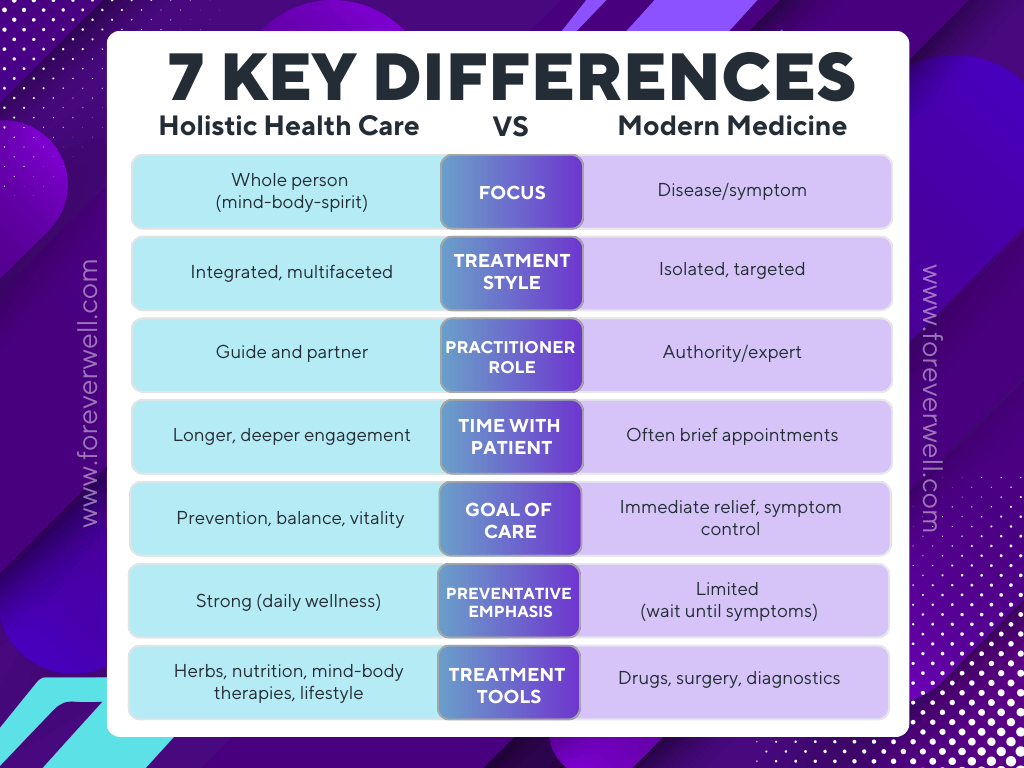
This comparison helps clarify what is holistic health care versus what modern medicine offers.
I speak of drugs working through the energy of interference, which is true, but modern medicine is driven by the overarching energy of heroic intervention. They built their stellar reputation in the arenas of trauma care and infectious disease very successfully with the energy of heroic intervention, and those are the areas where modern medicine continues to shine.
That same heroic intervention fails in the treatment of chronic and autoimmune disease. Drugs can suppress symptoms, which can be very helpful in conditions like migraine and irritable bowel syndrome, but it is not curative.

If you have a hectic lifestyle and no time or energy to implement the changes required by a holistic approach, then modern medicine can serve you for a time.
But if you are ready to understand who you are holistically and how various aspects of who you choose to be in the world can impact the quality of life you enjoy, and how some habits serve you and some don’t—then you are beginning to ask yourself again what is holistic health care really about.
If you are ready to learn and understand and embrace the role an empowered you can play in leading a healthy vibrant life then finding a qualified holistic care practitioner is exactly the correct prescription.
Patient Experiences with Holistic Health Care
Talking with patients of natural and functional medicine practitioners has been eye-opening over the years. Using their holistic approach to identify and resolve imbalances, these doctors guide patients into an understanding I will repeat over and over again: the best doctor you will ever find is the one you see in the mirror every morning. And that realization, too, reflects what is holistic health care in its truest sense.
Benefits of Holistic Health Care
Holistic care practitioners already know this, and the chart above reflects this difference. Not only do holistic doctors spend more time getting to know their patients, but they consider their role to be more “guide” and “partner” than “authority” and “expert”.

I deeply believe we are all blessed with an intuitive wisdom of self. That somewhere in our “knowing of self”, we understand where our imbalances are. When a doctor dismisses our instincts or our thoughts about what is wrong with us and reaffirms themselves as the expert, we are not well served.
Holistic care is different. The practitioners will often spend an hour or more with a patient on a first visit and most often ask the patient for their thoughts and suggestions on a path to healing throughout the process. It is empowering and inspirational to the patient. This is yet another example of what is holistic health care in action.
What Patients Say About Their Healing Journey
Here are some of the comments I’ve heard over the years from patients:
- “Once I realized that my choices could make such a big difference in my health, the choice became much easier.”
- “I was always so frustrated with my medical doctor, he never seemed to pay attention to what I thought.”
- “I know me and my body and I was so impressed that my naturopath actually listened to me and cared about what I thought”.
These reflections highlight both the strengths and the challenges of answering what is holistic health care in real-world practice.

Final Thoughts
Empowerment in health stems from the relationship you create with the doctor treating you. If they show no interest in knowing you in a holistic way, maybe it is time to consider a new doctor.